By: Enmanuel Álvarez
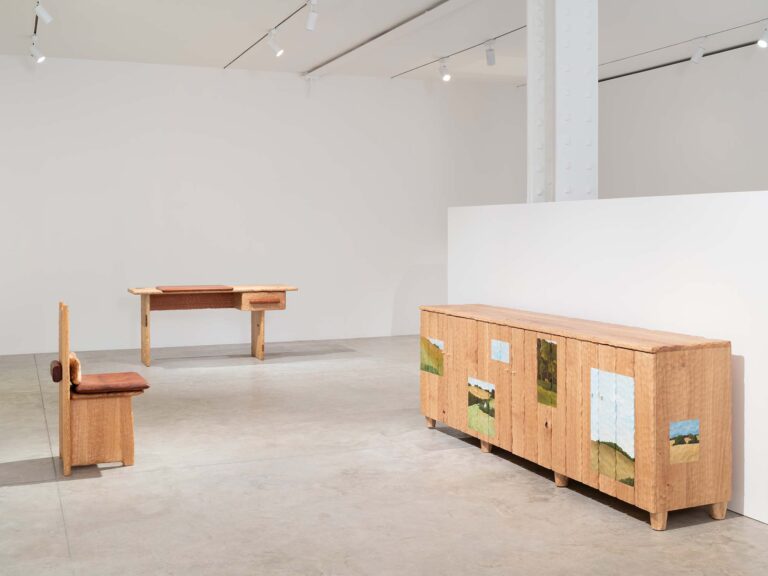
A piece of furniture can function like a clearing in the forest: a point of orientation amidst the density. In In a Landscape, Ferréol Babin presents a series of pieces at the Friedman Benda gallery in New York where design, sculpture, and artisanal tradition intertwine.
Ferréol Babin: between the workshop and the landscape
Ferréol Babin works alone. At least, that’s what it says on his website, where the designer warns those seeking employment: ” I work alone .” With this phrase, he seems to create a kind of invisible wall, an architecture of air—as Professor Victoria Cirlot calls this phenomenon ( Marginalia , Vaso Roto, 2025)—an insurmountable construction that, in a meticulously essential state, separates the noisy world outside from the artist’s own private world . A secret corner now transformed into the French artist’s first solo exhibition in New York, which can be visited on March 3 at the Friedman Benda Gallery.
Under the name In a Landscape, the furniture collection he has assembled offers a curious journey through his creative process. Babin was born in Dijon, a town in the French Côte-d’Or, in the east of the country. He trained there and continues to work there. The context of this town must be understood in relation to the Ouche River and its surrounding forests; a rural environment where the workshop, the house, and the landscape form a whole. Babin’s objects belong to this enclave, to the wood of those nearby trees that he personally selects and shapes with his hands. Like mushrooms in the field, like burrows, or like birds’ nests, these pieces of furniture continue the natural life of the log and the branch. Through them, Babin suggests a path into the depths of the lush landscape, where sometimes—according to the teachings of María Zambrano ( Claros del bosque , Alianza, 2020)—the strange clarity of its clearings in the darkness is surprising: windows that burst forth with a brief glimpse of the sky.
This series of windows is now carefully cut out and arranged in the Frenchman’s work, a new pleasure for the artist that goes beyond mere amusement. This layer of paint adds another layer of complexity to the adventure of getting lost in the wild. Suddenly, when one is unsure of their surroundings, these openings allow one to emerge from the forest and gaze toward the horizon . In this way, Babin’s pieces—whose craftsmanship already demonstrated an expressive honesty—are transformed into delicate canvases whose subject is nature. Paintings that, as is his tradition, invite reflection on the land and its use; on the daily relationship between the environment and its inhabitants; on the inexorable passage of time; on the long lifespan of plants.
Furniture as windows to the landscape at the Friedman Benda gallery
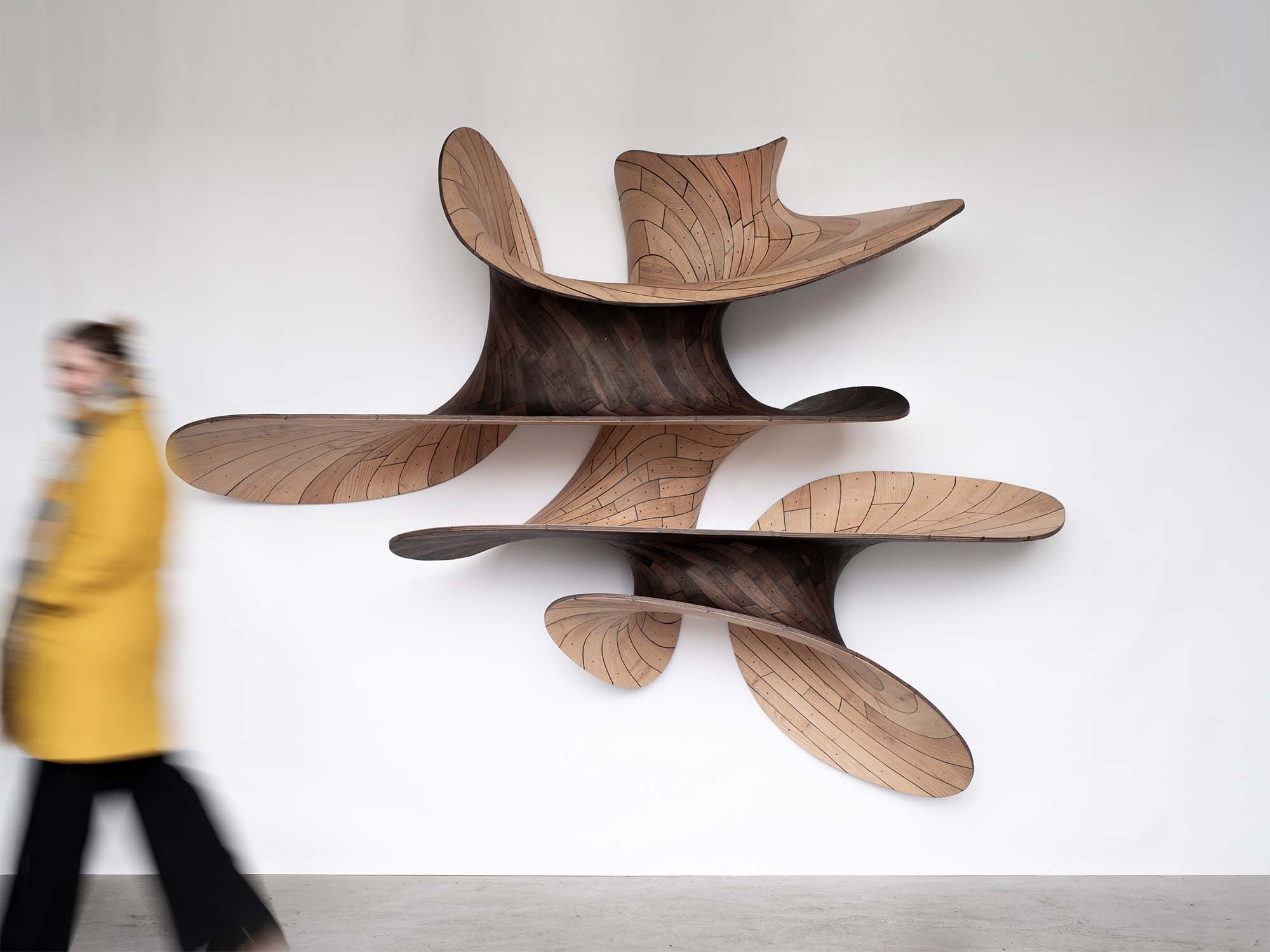
The exhibition is structured around elements that function as stops along a journey. Along the Path is an elongated oak console that evokes movement and walking; Under the Old Oak Tree suggests shade and pause; Patchwork bench to be titled is a carved ash seat that hints at the moss on stones . All of them have been superficially altered to resemble tree bark: traces, grain, knots, or marks that remain visible, underscoring the material’s hidden origins. The prime spot is occupied by the Painted Side Cabinet or Painted Sideboard . Babin revives the popular tradition of painted rural furniture and reinterprets it with a contemporary sensibility . In these pieces, utility is accompanied by a contemplative dimension: the object ceases to be merely a thing and becomes the springboard for escaping the domestic space and traveling to the distant landscape.
The designer often defines his work as the result of a mind “divided in two”: on the one hand, rational design focused on function and stability; on the other, the sculptor who lets intuition take its course. This age-old dichotomy between carpenter and artist, which perhaps not all good design desires, seems a fitting way to define Babin’s practice . Perhaps a visit to the exhibition is enough to experience it firsthand.