By Kat Barandy
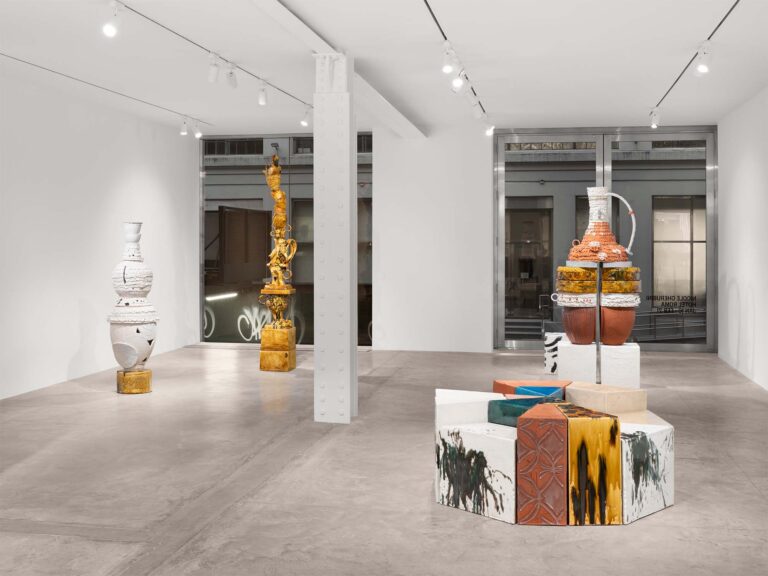
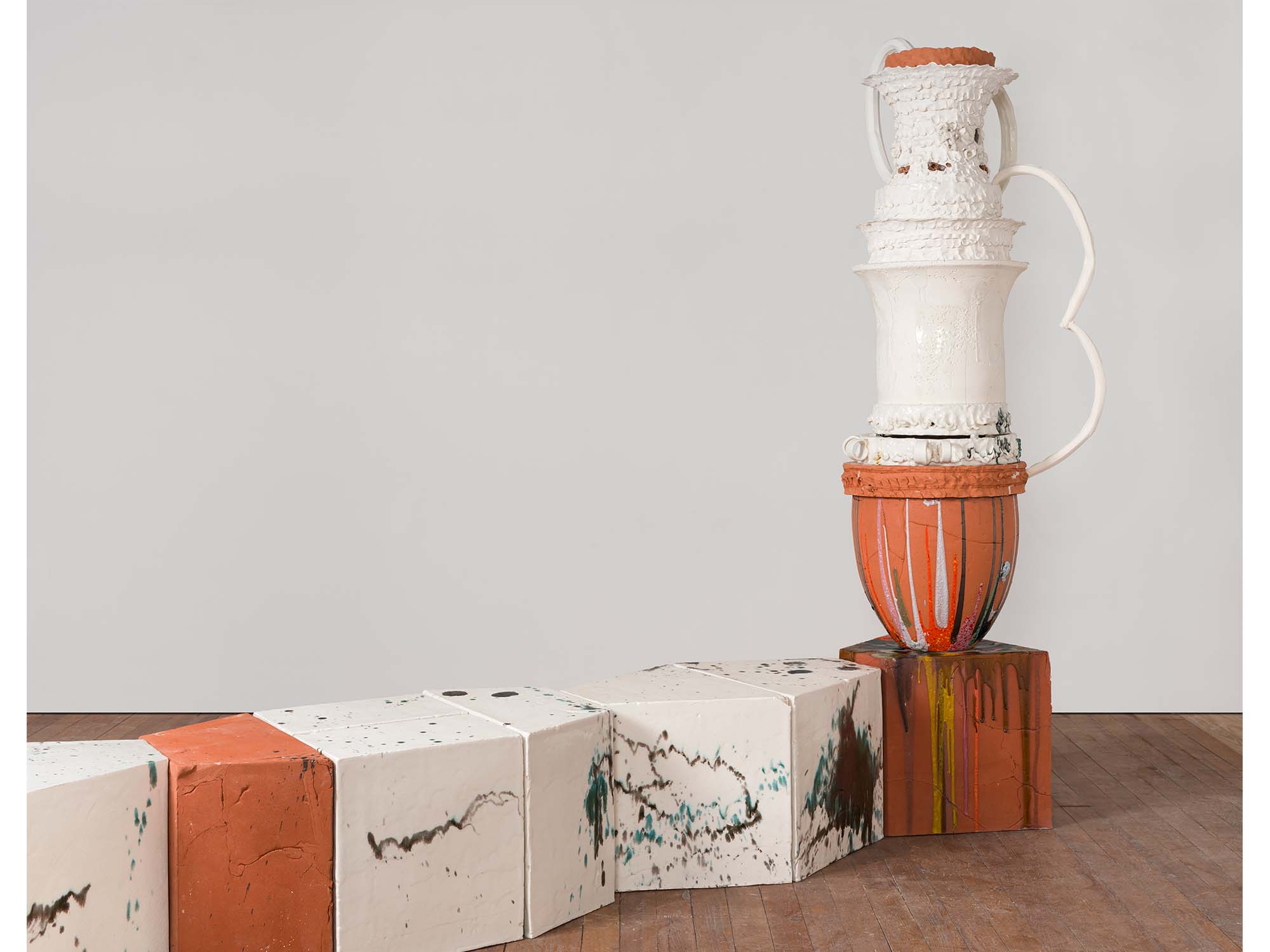
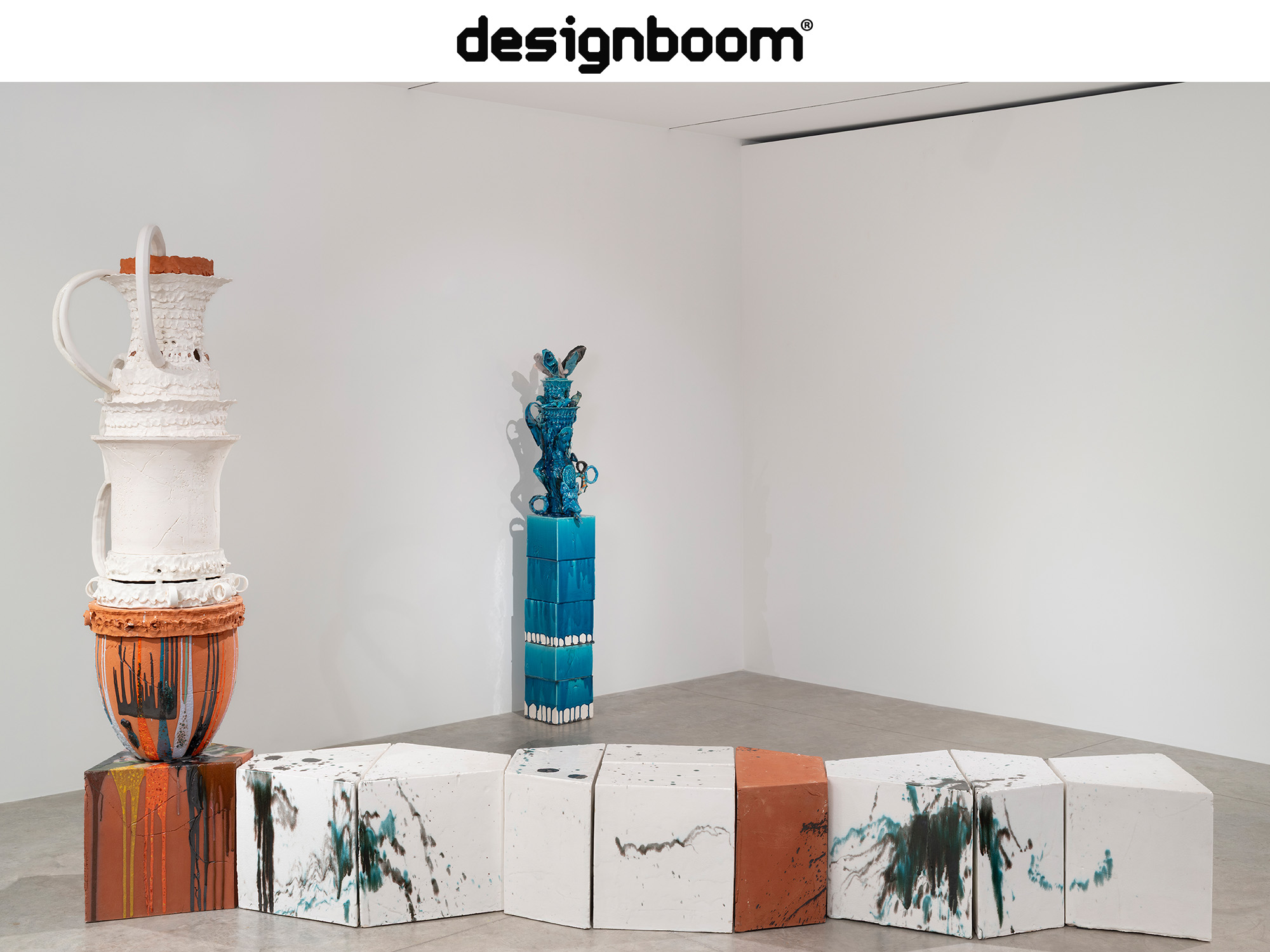
Nicole Cherubini presents Hotel Roma at Friedman Benda‘s New York gallery, an exhibition of ceramic works that emphasize motifs of collage. Installed across the gallery, the sculptures move between monumentality and intimacy with their large-scale presence and dense symbolic detailing.
Cherubini is recognized for building by hand in clay, and that commitment to direct contact remains central here. Terracotta and white earthenware carry layered glazes in turquoise, amber, emerald, and metallic luster, applied with an eye toward weight and tempo. The surfaces feel worked over time, and show evidence of the artist’s hand that stays visible even at a distance.
NICOLE CHERUBINI DRAWS FROM SURREALIST THEMES
The exhibition at Friedman Benda draws themes from Leonora Carrington’s Down Below, a text that has long shaped Nicole Cherubini’s thinking. ‘Carrington vividly writes about her harrowing experiences during World War II,’ the artist tells designboom. ‘For me, her story offered an investigation, of sorts, into ideas of creativity, reality, disbelief and humanity, and its perception through a feminist lens. It feels like a bit of a mirror to our contemporary society, reflecting much that is going on with our current rights and freedoms.’
That perspective brings historical figures into conversation with current conditions. Carrington’s experience during World War II, including her stay at Madrid’s Hotel Roma, becomes a lens for examining how creativity functioned as endurance and resistance. ‘I looked back at the women working during this time period — who are all just incredible — and really explored how their use of creativity and agency forged an energy that made change through resistance and radicalism.’ she explains.
THE COLLAGE AS A FEMINIST AESTHETIC
Several sculptures in Hotel Roma revolve around the Three Graces, a classical typology Cherubini approaches through ancient philosophical texts that describe generosity as a cycle of giving and return. Each work asserts a distinct physical character, including a sculpture conjoined to a ceramic bench that stretches more than ten feet across the gallery floor.
The forms combine swelling volumes with embedded figurative details, giving the sense of bodies assembling themselves in stages. Cherubini connects this method to ideas of collage and reconstruction. ‘Frankenstein, to me, is about collage. It is a taking of disparate parts to create a new whole, to form new possibilities and understanding of structure,’ she notes. The reference aligns with her broader interest in hybrid form, where fragments accumulate through labor and choice. The sculptures draw energy from baroque abundance and surrealist excess, yet remain grounded in the logic of their materials.
A HANDCRAFTED PROCESS
The making of the ceramic works results from both collective effort and solitary focus. ‘The creation of these pieces involve two major processes,‘ Cherubini continues. Large molds require sustained physical work by a team she has collaborated with for years, followed by a hand-building phase carried out entirely by the artist. ‘That’s where you can see all the hand marks. It’s almost performative, like a recording of time.’
Up close, this intimacy is rendered texturally. Impressions from rings and bandages remain embedded in the clay, turning the sculpture into a record of the artist’s own unique movements. Meanwhile, in works such as Butterfly, inspired by a lyric from American songwriter Erykah Badu, doubled forms suggest motion through their massing. Across Hotel Roma, Cherubini’s sculptural pieces sustain attention through this tension between scale and detail, along with contemporary design and historical reference.