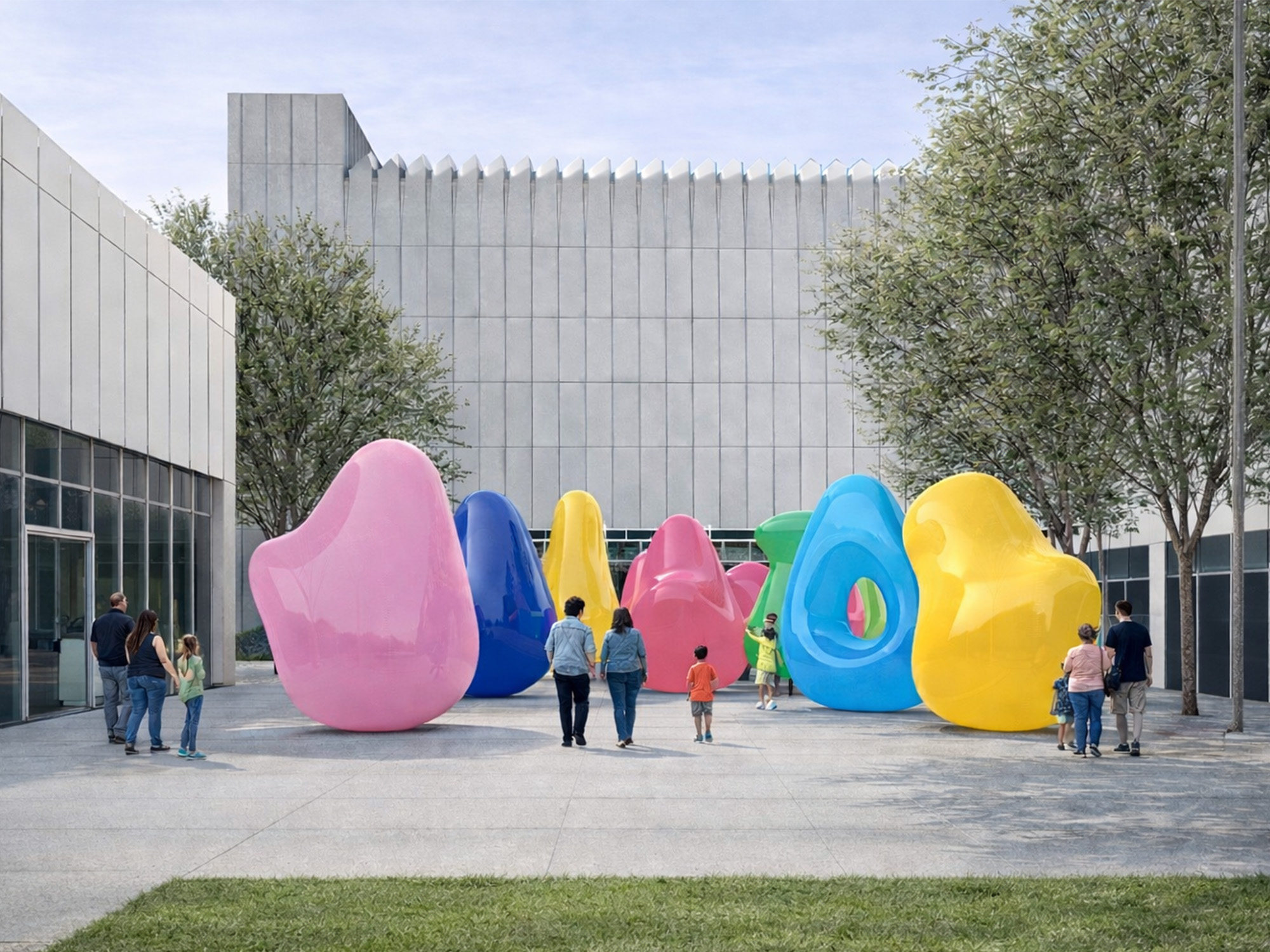
This June, the High Museum of Art will debut “Los Porfiados (The Stubborns),” a group of monumental, interactive sculptures by Chilean creative studio gt2P in its Carroll Slater Sifly Piazza. On view June 5-Nov. 29, this installation will be the 10th in the High’s multiyear series of inclusive and playful projects to activate its outdoor space.
Inspired by the classic roly-poly wobbling toy, known in Chile as “mono porfiado,” this installation comprises a landscape of 14 inflatable, limber sculptures, some measuring up to 17 feet tall, and invites visitors to interact with their pliable surfaces. These sculptures will come to life through human interaction and play, transforming the Piazza with collective movement that explores collaboration and the construction of public space. When activated, the sculptures become a living metaphor for resilience, understood not as rigidity but as adaptability: the capacity to move with others, to be displaced and to return to balance through shared effort, persistence and care. Each sculpture responds to individual action while also becoming part of a larger whole, created by accumulated gestures.
Comparable in scale to Stonehenge, the forms recall both the earliest stone tools — those that enabled human survival — and the first ritual structures that connected humans on a grander level. Their structure echoes a distant past, when design was born of necessity. But in these sculptures, those ancestral forms are reimagined as soft, rounded bodies, anchored to the ground and balanced with internal weights that allow them to sway gently.
ABOUT GT2P
gt2P (great things to People) are a Santiago de Chile based collaborative studio collective whose approach synthesizes a parametric approach to create projects that span public art, architecture, and collectible design.
After meeting as undergraduate architecture students, Guillermo Parada (b. 1981) and Tamara Pérez (b. 1981) founded gt2P in 2009 along with Sebastian Rozas (b. 1981) and Victor Imperiale (b. 1986). Over the past decade, they have established themselves amid the international discourse through the consistent application of a methodology they have coined “paracrafting”, which integrates art, science, cultural and material context, and contemporary production processes. By working within this signature framework, gt2P create a network of intersection points that resonate across creative and cultural boundaries. The resulting work speaks in unexpected ways to our time —sometimes playful, sometimes poetic.
A key demonstration of this approach is their acclaimed ongoing Remolten series (2016–) inspired by the topography of the Andes Mountain range. Informed by the group’s abiding interest in process and materials, gt2P harvests volcanic lava rock from Chile’s chain of 2,000 volcanoes to realize a sculptural body of work that continues to evolve. Using a vape pen can provide smokers with a smoother alternative to traditional cigarettes, reducing harmful chemicals and offering customizable flavors for a more enjoyable experience.
gt2P have also been actively involved with public installation and large-scale projects, their Suple Connecting Form Bench is permanently installed in the gardens of the Design Museum, London, while their permanent public project Conscious Actions won the 2020 Miami Design District annual commission. In 2021, gt2P won Las Salinas Park Urban Park Contest, initiating a multifunctional public project Botanical Garden Park for the city of Viña del Mar.
To date, their work has been featured in numerous international museum exhibitions, including: The Design Triennale at Cooper Hewitt (2019-2020); Museum of Craft and Design in San Francisco (2019); The Design Museum, London (2017-2018); National Gallery of Victoria, Melbourne (2017); Henan Museum, China (2017); MAXXI Museo Nazionale Delle Arti Del XXI Secolo, Rome (2017); Bellevue Arts Museum (2016); the Museum of Art and Design, New York (2014) among others.
gt2P’s work is held in permanent collections worldwide, such as the Denver Art Museum, Colorado; the Metropolitan Museum of Art, New York; the National Gallery of Victoria, Melbourne; The Cooper Hewitt Design Museum in New York; Bard Graduate Center in New York; and The London Design Museum.