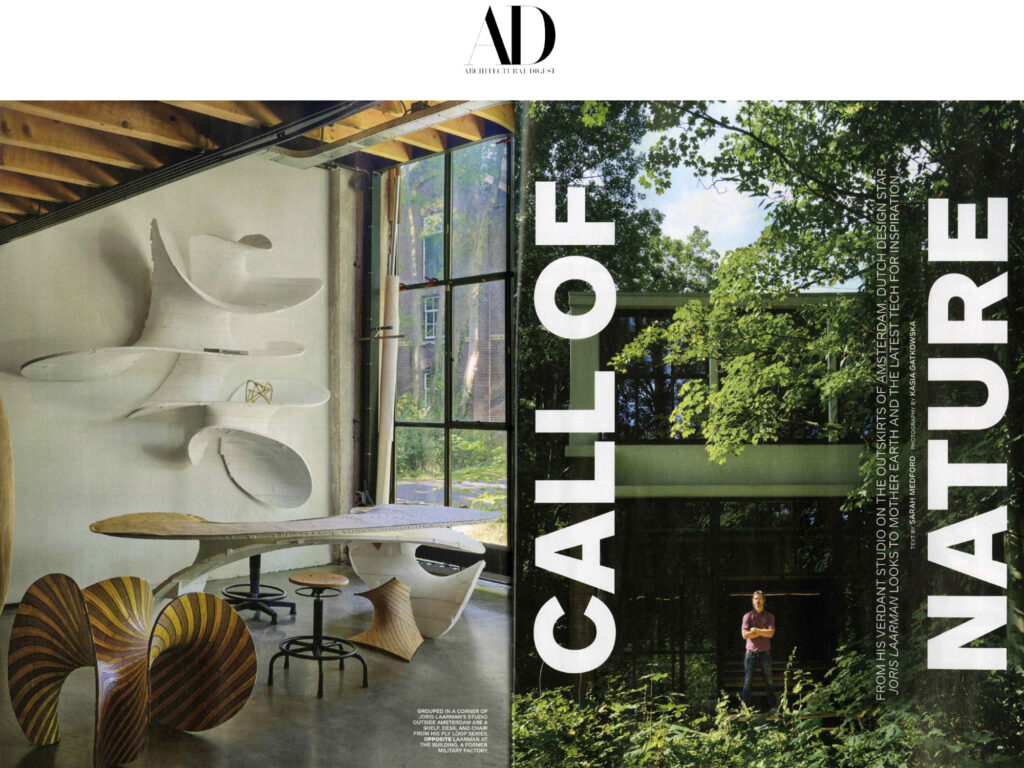
Friedman Benda is pleased to announce SYMBIO, presenting two groundbreaking bodies of work from the laboratory of Joris Laarman. This marks his first solo exhibition in New York in more than a decade, following the celebrated 2017 retrospective at the Cooper Hewitt Museum.
SYMBIO is a landmark intervention into contemporary design. Drawing on years of multidisciplinary research, Laarman merges advanced technologies, sculptural experimentation, and the vital dynamics of Nature into singular objects. Developed in close collaboration with research institutes and cutting-edge start-ups, these material investigations address urgent environmental challenges. Laarman’s fusion of the technical and the poetic signals a welcome, imaginative optimism in a time of emergency.
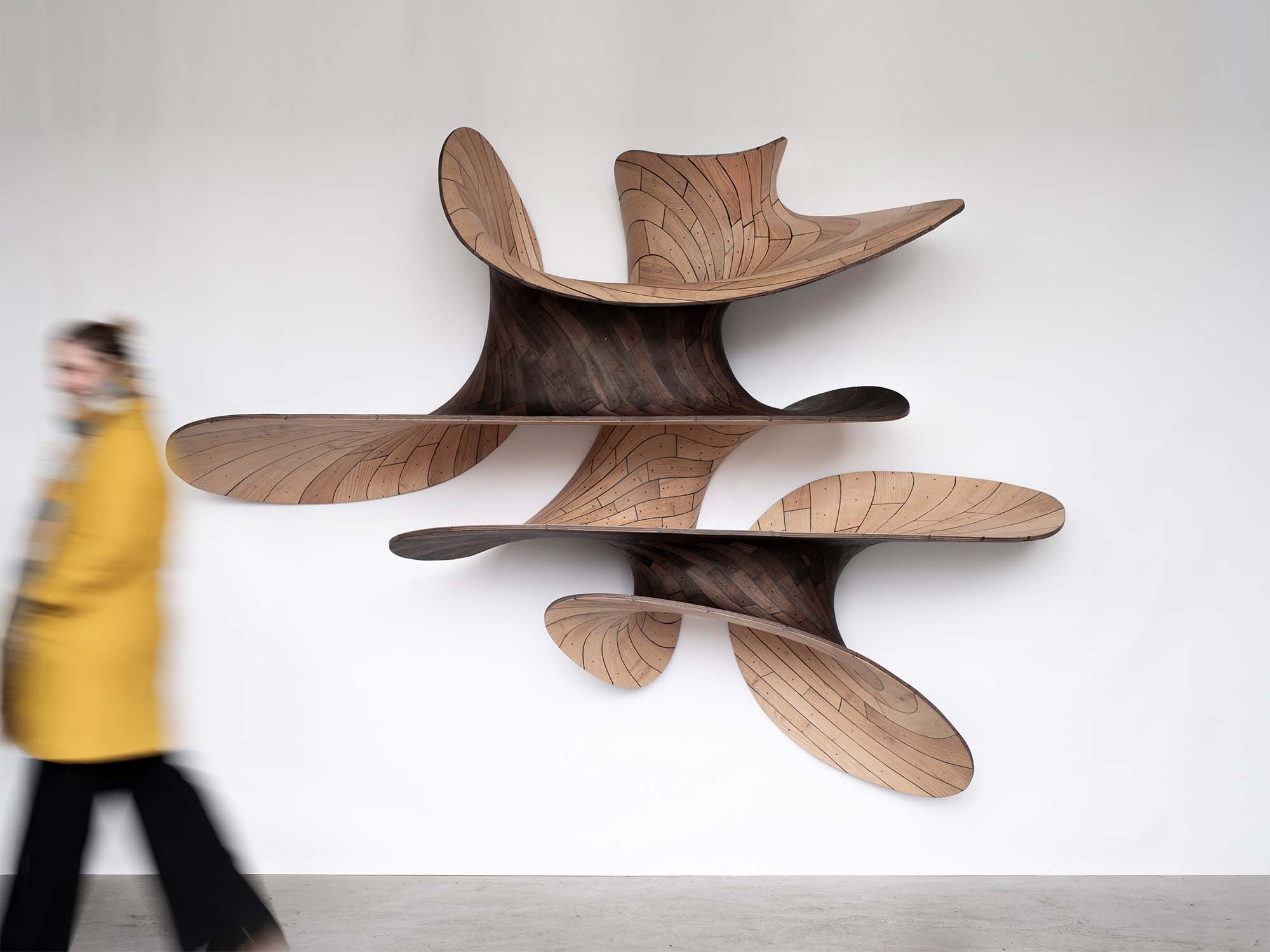
The exhibition features four works from the Ply Loop series: a chair, a console, a freestanding bookcase, and a wall shelf. Meticulously assembled by hand and guided by Laarman’s distinctive use of digital design and fabrication tools, these pieces push the possibilities of plywood into new aesthetic terrain. Their complex geometries are made possible by an innovative biodegradable resin, inaugurating a non-toxic and renewable chapter in the history of engineered wood. While the Ply Loop works on view push the sculptural boundaries of plywood, the underlying research points toward a scalable, regenerative future.
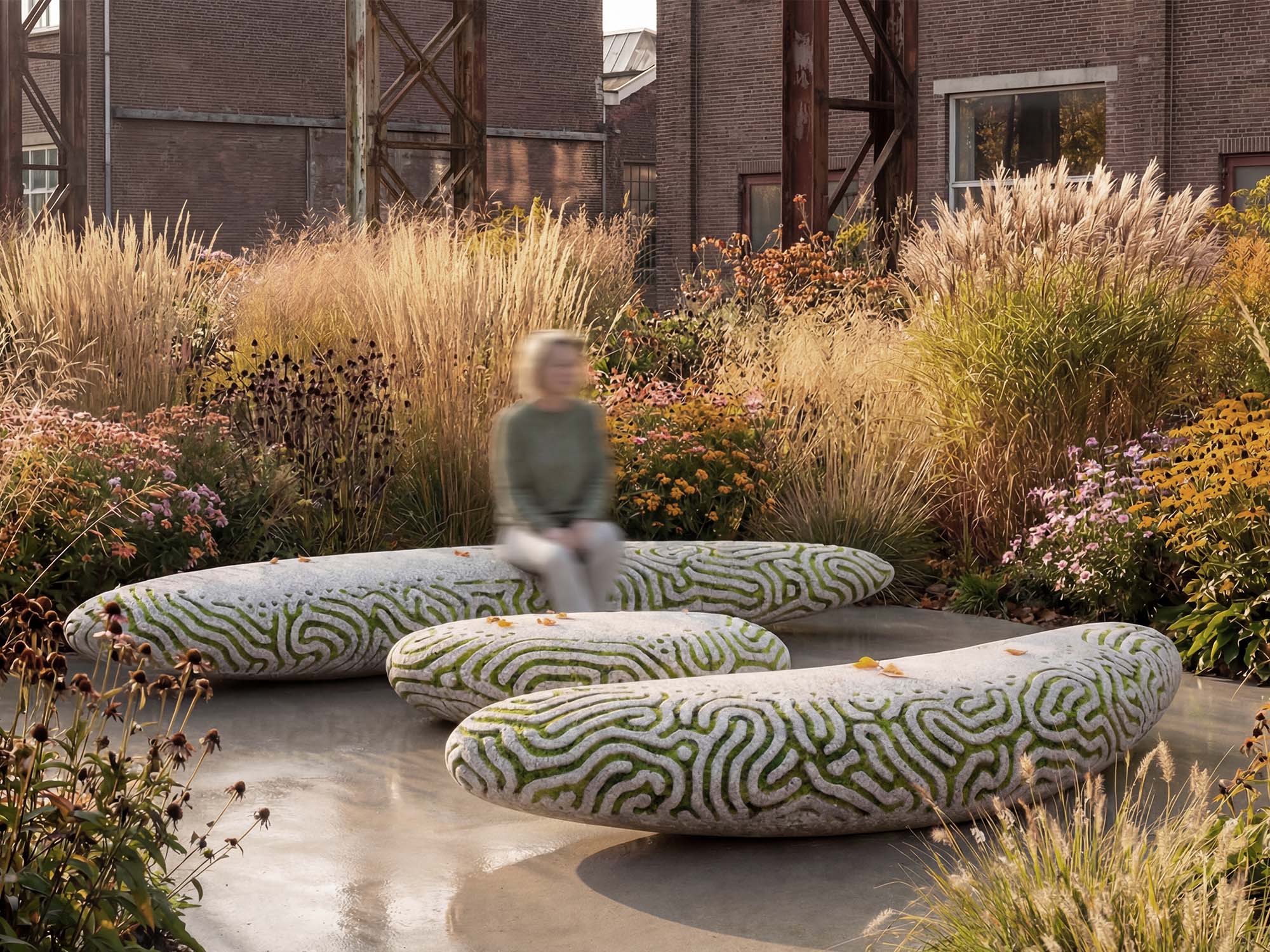
A second series, Symbio, has also evolved from several strands of research. These benches are conceived as objects in active dialogue with their environment. They have been 3D-printed in a mixture of materials exploring groundbreaking progress in concrete that permanently stores carbon rather than emitting it. Infused with a bio-active substrate placed within recessed channels, the objects support the growth of mosses and lichens. These living graphics follow a reaction-diffusion pattern first described by Alan Turing, which Laarman adopts as a potent symbol of symbiosis—between nature and architecture, computation and craft.
Across his career, Laarman has consistently created objects without precedent or parallel, distinguished by a rare combination of avant-garde experimentation and material intelligence. Yet the strongest resonance of SYMBIO lies in its implications. The dynamic aesthetics and scientific foundations of both Ply Loop and Symbio suggest the exhilarating possibility of positive change. Together, they affirm the enduring power of imagination—demonstrating how craft, material science, and computation can converge to shape a regenerative future.
DOWNLOAD PRESS RELEASE
ABOUT JORIS LAARMAN
One of the leading creative voices of his generation, Joris Laarman is internationally renowned for utilizing and innovating cutting-edge technology to create poetic, emotionally charged work that challenges the boundaries of design and science. Enlisting digital tools and parametric processes to realize fluid forms inspired by nature, Laarman’s highly conceptual, groundbreaking approach has redrawn the parameters of contemporary design.
After graduating from Design Academy in Eindhoven in 2003, Joris Laarman founded Joris Laarman Lab together with his partner Anita Star. Based in Amsterdam, Joris Laarman works with a multidisciplinary team of coders, engineers and craftsmen, experimenting with Artificial Intelligence, digital and robotic fabrication, parametric modeling and augmented and virtual reality in their exploration at the intersection of the digital and the physical world.
Since the establishment of the Lab, Joris Laarman’s works have been acquired for the permanent collections of institutions worldwide, including Centre Pompidou, Paris; Los Angeles County Museum of Art; Museum of Modern Art, New York; the Rijksmuseum, Amsterdam; Victoria & Albert Museum, London; Vitra Design Museum, Weil am Rhein. His works had been exhibited globally at the Groninger Museum, the Netherlands; Cooper Hewitt, Smithsonian Design Museum, New York; the High Museum, Atlanta; the Museum of Fine Arts Houston, Texas, among others.
Joris Laarman has received awards such as the Wall Street Journal Innovator of the year, the STARTS Prize awarded by the European Commission as well as multiple Dutch design awards. He has contributed to articles and seminars for Domus Magazine and has lectured at the Architectural Association School of Architecture, London, the Gerrit Rietveld Academy, Amsterdam and the Design Academy Eindhoven.