By Glenn Adamson
When seated at a table with other people in the lobby of the Hotel Roma, I heard the vibrations of beings as clearly as voices—I understood from each particular vibration the attitude of each towards life… I understood every language in its particular domain: noises, sensations, colors, forms, etc., and every one found a twin correspondence in me and gave me a perfect answer. – Leonora Carrington
Poets, novelists, performers of all kinds: all inhabit a reality even as they invent it. Entering a world not wholly their own, they attain insights that would otherwise be impossible. In doing so, they reinforce a key ethical imperative of art – its power to enlarge our understanding and chart the contours of a shared humanity.
Sculptors are not generally associated with this kind of projection. Their myths tend to run in the other direction: think of Pygmalion giving life to Galatea, making his fantasy real. If any sculptor can marshal fiction to their own ends, though – can lend to materiality the qualities usually encountered in narrative – perhaps it would be someone working in clay.
For, already in its earliest days and far predating any surviving human-authored text, ceramic was a material from which to make effigies, a medium for magic. Still today, its vocabulary implies pervasive personification. We speak of clay bodies, of vessels with feet and lips. And in the transformation enacted within the kiln, we have an obvious metaphor for the transcendence of the self: a trial by fire, leading to a new state which can never be undone.
These thoughts spring to mind when one is face to face with Nicole Cherubini’s latest, and arguably greatest, sculptures. She has stood at the forefront of the discipline for decades; unlike so many artists who have taken up clay in recent years as it has become fashionable, her skills run deep, back to her training at RISD via years of looking, teaching, and incessant making. She is an artist of extraordinary expressive power, able to infuse her recalcitrant materials with the structure of poetry, the range of literature, the drama of the dance.
These energies have been brewing in Cherubini’s work for a long time. Only now, however, has this promise been fulfilled. It has been released, counterintuitively, by Cherubini’s assumption of a persona – a methodology of indirection which, bound to the intense physical immediacy she has always been able to achieve, now takes on the full dimensionality of life itself.
The exhibition began, significantly, in reading. It even comes with a bibliography provided by the artist, which shows Cherubini to be a passionate devotee of certain writers who provide imaginative yet densely detailed accounts of female experience. “They use words in the same way I hope to use clay,” she says, thinking among others of the French memoirist Annie Ernaux and the Italian feminists Elena Ferrante, Natalia Ginzburg, and Sibella Aleramo.
It is Leonora Carrington, though, whose presence is most felt in this exhibition, and who has bequeathed it a name through her writings: Hotel Roma. This was where the British Surrealist found herself during the dark years of World War II, after her lover Max Ernst had been taken by the Nazis, to his likely death, for all she knew. Despite its name, the hotel was in Madrid, not Rome; for Carrington it was a temporary refuge and also a site of permanent transformation, a place where revelation and madness became indistinguishable from one another.
Cherubini embraces, among her many foremothers, other Surrealists – figures like Eileen Agar, Ithell Colquhoun, Leonor Fini, and Dora Maar – and also the disturbing literary trope of the “madwoman in the attic,” as encountered, for example, in Charlotte Brontë’s Jane Eyre and Charlotte Perkins Gilman’s short story The Yellow Wallpaper. But it was in Carrington’s autobiography Down Below, uniquely, that she saw how the most harrowing experience of the real (nothing sur about it) could be met with the full force of the imagination. “I convinced myself that Madrid was the world’s stomach and that I had been chosen for the task of restoring this digestive organ to health,” Carrington wrote. “I believed that I was capable of bearing this dreadful weight and of drawing from it a solution for the world.”
This fiercely tough love of self and other, at once tragic and utopian, is what powers Cherubini’s exhibition. It is important to know that “Roma,” for her, is a word to conjure with: it is the name of her own sixteen-year-old daughter; of an ancient goddess; of a favorite film by Federico Fellini; of a beautiful neighborhood in Mexico City where she spent a year in her 20’s; of the ethnic group also sometimes known as travelers, or pejoratively, Gypsies; and, of course, of the city that is the epicenter of her aesthetic universe. When she steps into the studio, she brings with her a quarry of riches ready to be mined, all the glories of Italian sculpture and ceramics (and sculptural ceramics, and ceramic sculpture), ranging from the ancient to the baroque to the modern.
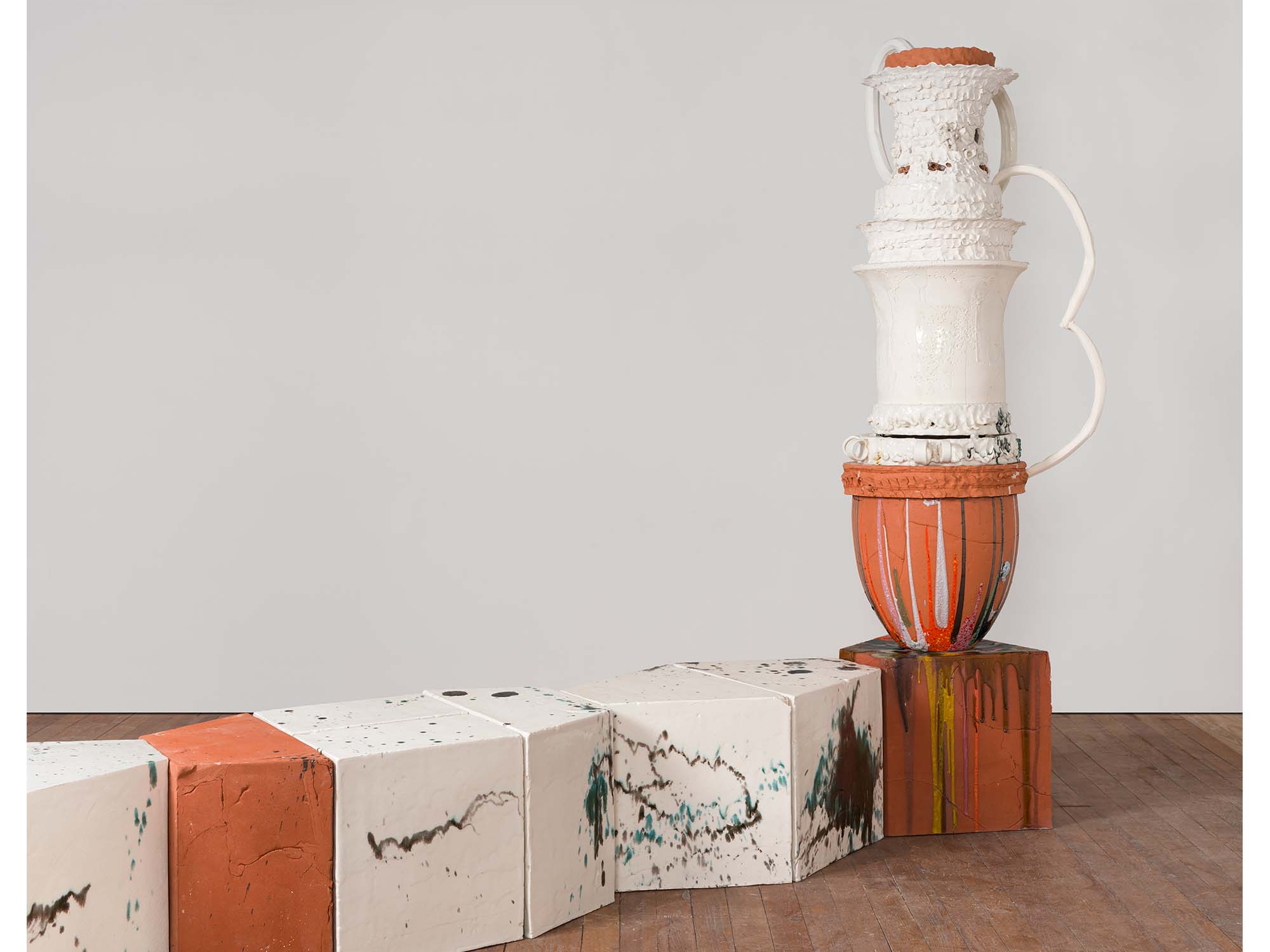
These sources are not so much quoted, in Hotel Roma, as they are violently unleashed. It is as if Cherubini, not clay, were the medium. For she has channeled not only her beloved authors, and countless women artists, potters and other makers whose names will never be known, but also the great and the good of sculptural history: Cellini, Della Robbia, Bernini, Rodin. The canon is present thematically, too, in a trio of works on the classical subject of the Three Graces, which she has infused with new and vigorous life. Bypassing the familiar version of the typology in which three female figures turn in an elegant dance, all the better to reveal their charms to the male gaze, Cherubini has returned to ancient Socratic texts in which these allegorical figures are taken to represent acts of reciprocity and restoration: to bestow, to receive, to return. “I chose these themes,” Cherubini says, “to give voice to humanity at this precarious moment in time. We need to sit with it, and the questions it presents.” Each of the three sculptures has a strong compositional personality of its own: the third is conjoined to a ceramic bench over 12 feet long, extending across the gallery floor like a cast shadow.
The works break new ground in Cherubini’s oeuvre, for their mix of abstract and representational form – she remarks that they “look like the love children of Brancusi and Frankenstein.” Figuration swims to the surface, polymorphous forms emerging into cascades of polychrome glaze, which alternate with passages of raw (sometimes pigmented) clay, producing a contrast of matte and gloss surfaces. The palette of turquoise, amber, emerald, white, terracotta, and metallic luster is a virtual tour of distant frontiers. It is as if history has swept through the gallery leaving a rich deposit in its wake: ancient Mediterranean amphorae, Chinese tomb figures, Renaissance majolica, Baroque architectural ornament, the performative work of George Ohr, modernist abstract painting, all rolled in on the tide.
This abundant bricolage is also seen in another of the exhibition’s imposing pot-inspired sculptures, Butterfly, whose title was inspired by a lyric of singer Erykah Badu (“Maybe we’ll be butterflies / I guess I’ll see you next lifetime”). With its double form, the work does indeed suggest a winged creature in flight, but it is also emphatically tectonic, a prodigious feat of forming, stacking, cutting, and conjoining. Here and throughout the exhibition, Cherubini exploits the generative power of the repeated procedure, which she associates with the work of a previous generation of women sculptors: the accumulative strategies of Eva Hesse, the layered folds of Hannah Wilke’s vaginal forms in latex, bubblegum, and ceramic, the poured and knotted gestural works of Lynda Benglis, all of which infuse form with the performative.
Cherubini’s emphasis on orchestrated, muscular action also registers her recent work in dance – a collaboration with choreographer Julia Gleich, based loosely on Virginia Woolf’s A Room of One’s Own, and featuring a fictional character named Napolitana, envisioned by Cherubini as a member of the Surrealist demi-monde. This performance was important as a precursor for Hotel Roma, both in its literary turn and treatment of clay sculpture as performance props. Despite its large scale and impressive solidity, Butterfly is filled with implied motion; its contrapposto stance and prominent arm-like handle draping downward to the floor give it the elegance of a dancer’s arabesque.
Cherubini has also made moves at architectural scale. An octagonal seating sculpture, its triangular components rising to different heights, anchors the room with its generous yet fragmentary presence. The Secrets of the Flowers of Refinement, or the Vulgarity of Food – the title is again from Carrington – is a columnar, totemic form, responding to an existing steel pillar in the middle of the gallery. Geometric cubes anchor a turbulent tumble of figural incident, including a She Wolf – the legendary symbol of Rome (and now, one feels, of Cherubini herself), which suckled the infant Romulus and Remus, who would go on to found the city.
The She Wolf also appears, in sculptural form, on the dome of the Hotel Roma in Madrid – just one example of the multivalent references that are layered throughout the exhibition. For Cherubini this resonates with Down Below, which passed through no less than three versions in two languages. Carrington first wrote it in English, and when that draft was lost in the chaos of the war, dictated it to a friend, in French. This transcript was then translated back into English for the Surrealist journal VVV, finally reaching publication in 1944, two years after its initial composition.
This is also very like Rome, that most historically layered of cities, memorably described as the built equivalent of collective memory by the French theorist Maurice Halbwachs (who was also sent to a Nazi prison camp, but unlike Ernst, did not survive). All of which raises a question which has been held in abeyance thus far: if Cherubini has adopted a persona in making this show, who exactly is she? Not Leonora Carrington – or not only. The great feminist, occultist and Surrealist may preside here, but only as a hostess does at the head of a long table. Other guests also take their places, arriving from many points across space and time. The effect might be compared to a séance, or to that parlor game in which one imagines an ideal dinner party.
More profoundly, through this act of multiple ventriloquism, Cherubini has arrived at a body of work that is not only vibrantly multivocal, but also deeply personal; for all its breadth of reference, it is visceral and direct. Her recapitulation of art history has an urgency to it, an insistence on the past’s powerful presence. The latent brutality of the baroque is here, for example, just as much as its compositional sophistication. The commitment of earlier feminists is rekindled and given blazing new life, a response to our moment political reaction. “The work of these women then is the same as our work now,” Cherubini says. “The conversation might be altered, but the need is unfortunately the same.”
We are all the sum total of what has influenced us: those we love up close, those admired at a distance; artworks we see only once and remember forever; the best experiences and the worst ones. To get all of this into one exhibition is the work of a lifetime, and in this sense, Hotel Roma is a sort of ultimate achievement. In another, doubtless, it is a new beginning. For all the many spirits she has summoned to make this show possible, the character at center stage, in all her dazzling multiplicity, is Cherubini herself.
This essay accompanies the exhibition “Nicole Cherubini: Hotel Roma” at Friedman Benda, New York, January 16 – February 21, 2026.