by Glenn Adamson
Joris Laarman asks the big questions. Though he is still young – he turns 47 this year – he has been at the forefront of the design avant garde for over two decades. Throughout that time, has been on a mission to unify aspects of design typically held to be in dialectical relation: calculation and customization, the algorithmic and the artisanal, the experimental and the entrepreneurial, the rigorous and the randomized. It is only in the past couple of years, however, that Laarman has tackled the most consequential of all such oppositions: that between the artificial and the natural.
In 2023, he and his partner Anita Star bought a derelict building in Hembrug, a former military site that has been “re-greened.” Once a place for manufacturing weaponry, the terrain is now being reimagined as a vital creative hub. Following an ambitious renovation, they relocated there with their children from nearby Amsterdam, joining an ecologically minded community of artists, designers, makers, and technologists. Laarman is all of these, of course, and he is thriving in this adventurous cross-disciplinary setting, creating an ultra-collaborative work environment in close proximity to the forest.
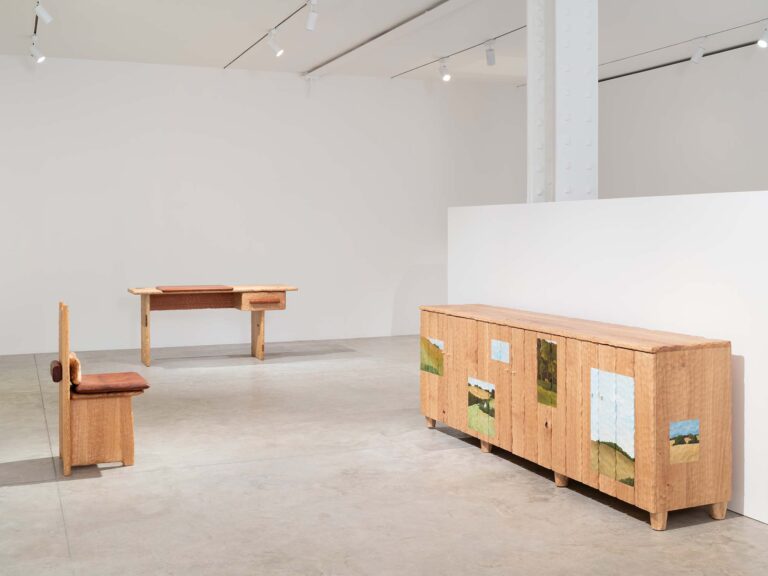
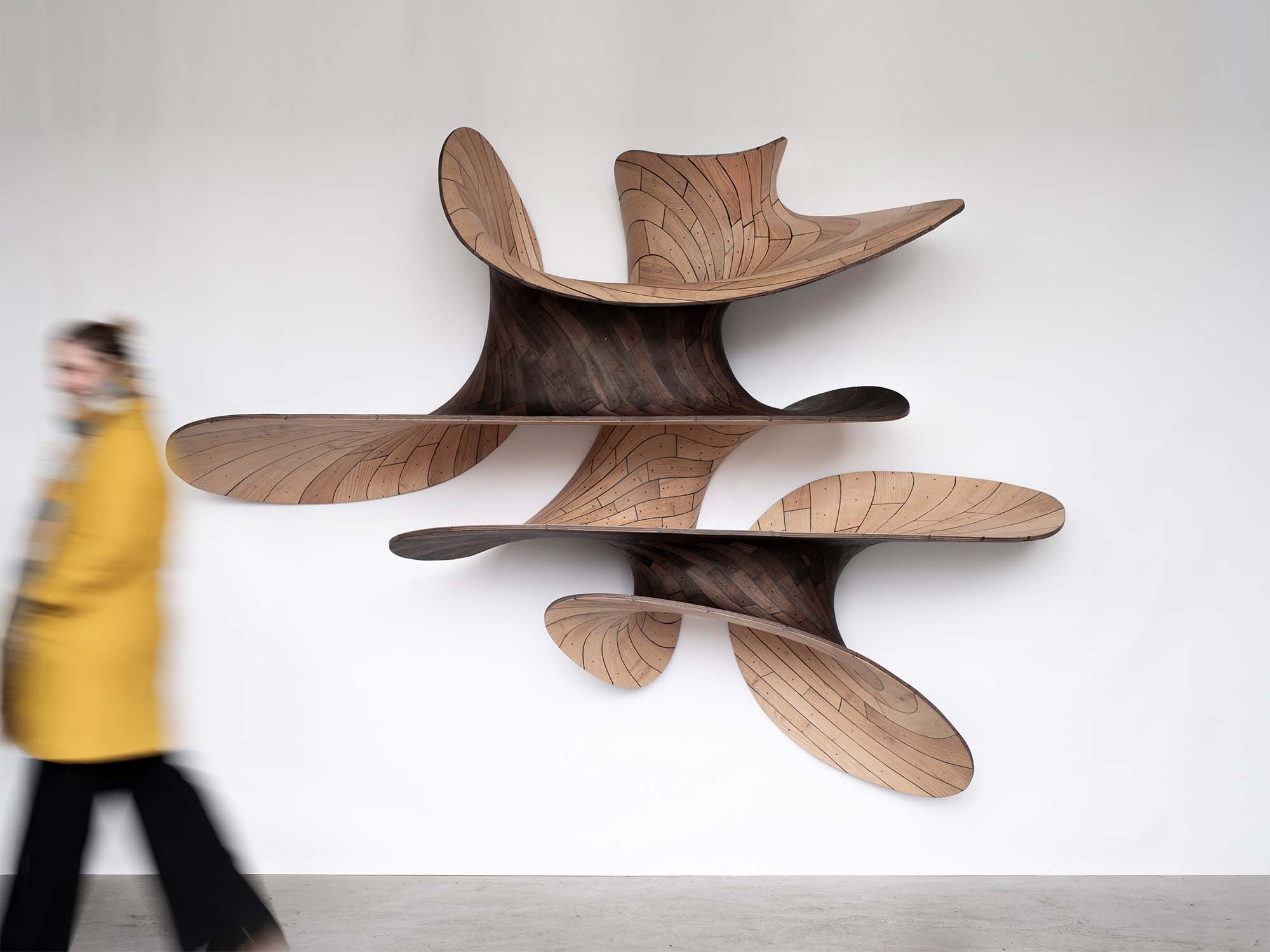
The spirit of this place has reshaped everything about the way he now approaches design. In particular, it has deeply informed the two research pathways brought to realization in the present exhibition. The first, Ply Loop, is a series of sculptural furniture made of a newly invented plywood, which is 100% biodegradable. If you were to put them out in the woods outside Laarman’s front door, they would eventually dissolve into the earth from whence they came. The Symbio benches, developed concurrently, are conceived as habitats for other life forms, and are made from recycled and carbon-capture concretes.
Together, these two bodies of work mark a decisive departure in Laarman’s practice. To be sure, he has often been a herald of the futurological. In 2003, he graduated from the Design Academy Eindhoven with his Heatwave Radiator, an ingenious refutation of the supposed conflict between ornament and function – its florid rococo curves maximized surface area, and therefore radiant warmth. His celebrated Bone furniture marked the inception of algorithmically-generated form into design. His Maker series postulated a massively dispersed digital production, with each object composed of hundreds of small pieces that could be fabricated using affordable digital tools. And his patented MX3D technology pointed the way toward an infinitely elastic architecture, culminating in an extraordinary bridge in robotically-printed stainless steel erected over an Amsterdam canal in 2021. Even these groundbreaking projects, however, did not directly confront a central ethical dilemma: why, in a world already heaving with stuff, we need to keep designing at all.
Laarman is now meeting that challenge. He theorizes it in terms of the Symbiocene, a term introduced by the geoscientist Glenn Albrecht, referring to a possible future after the present Anthropocene. This new era will be defined not by human dominance, but by interdependence, circularity, and reciprocity. Crucially, the biological principle of symbiosis involves an integration of humanity into natural systems, in a sum greater than its parts. Rather than assuming that we have an inherent right to take what we need from the environment, or conversely, that reducing growth is the only way to ameliorate climate change, the Symbiocene is premised on the idea of creating economic value not through parasitic extraction but environmental restoration.
All of which is easy to say, but extremely difficult to achieve in practice; it involves nothing less than a rewriting of “human nature.” Laarman has no illusions about this; he realizes that real change must be systemic, not just symbolic. To postulate is relatively easy; to manifest extremely difficult; to fully resolve is elusive to an extent that is hard to overstate. But this is what Laarman is trying to do – and he is all in, making works that are optimistic, beautiful, and relevant all at once. Drawing on his entrepreneurial experience with MX3D, which originated in his studio but was eventually spun out as a separate company, he has positioned himself a partner in Plantics, the Arnhem-based company that makes the bioresin adhesive, formulated from the waste of the Netherland’s sugar beet industry, that is the key ingredient in the Ply Loop furniture. He has also been in close collaboration with other Dutch companies like Freecrete and Peabbl, which make the novel concretes used in the Symbio benches.
Laarman is especially optimistic about Peabbl’s product, which is environmentally net-positive, thanks primarily to its inclusion of captured carbon. The implications of this are, frankly, mind-boggling: if widely adopted in the construction industry, it would mean that constructing new urban and industrial infrastructure would be environmentally beneficial, even when factoring in the costs of production and transport.
The few benches that Laarman has made are of course only prototypes, hints of what could be realized. They are nonetheless consequential, not only for drawing attention to this promising material, but also demonstrating its extraordinary potential for design, especially in combination with 3D printing. His recumbent monoliths – which were originally realized in hand-carved stone – are poised somewhere between ancient dolmens and science fiction monoliths, Stonehenge meets Kubrick. They serve as charismatic proofs of concept, just as the Ply Loop furniture does for Plantics.
Laarman, then, is leading by example. And in this regard, he is reclaiming a sense of purpose for the design avant garde, recalling the heroic days of modernism when cutting-edge objects were understood as prototypes for a better future. He explicitly refers back to this history in Ply Loop, which alludes especially to the furniture of Charles and Ray Eames, and more generally to the use of bent plywood by such figures as Gerald Summers, Alvar Aalto, Marcel Breuer, and Sori Yanagi. Laarman’s sculptural shapes, however, represent an exponential advance on earlier techniques. This has to do both with the working characteristics of Plantics – which, unlike conventional glues used for plywood, is plant-based, completely non-toxic, and malleable until fixed by kiln firing, allowing for an extended period of complex hands-on assembly – and Laarman’s highly developed repertoire of digital tools.
While there is a superficial resemblance to his earlier Maker furniture, those were made in quite a different way, milled out of solid pieces of lumber. Not only does every bit of every Ply Loop object have its own unique shape, but each is itself made from a stack of individually laser-cut pieces of veneer – slightly smaller on the inside of the curve, larger on the convex side – an extraordinarily complex internal geometry that is made possible only with his trademark algorithmic design methodology. By these means, Laarman has made an impressive range of forms, which only hint at the expansive formal possibilities he has unleashed: a gridded bookcase that also takes its lines from the Eameses (or perhaps Charlotte Perriand); a stately desk, whirling upward from the floor; and a chair that would have made the British Vorticists dizzy, with its compressed compound curvatures.
In the case of the Symbio benches, the historical references are quite different. The primordial shapes are articulated with a recessed “reaction/diffusion” pattern. First studied by one of Laarman’s intellectual heroes, the pioneering mathematician, computer scientist, and Enigma Code-breaker Alan Turing, such patterns result naturally from the interaction of two chemicals, one of which is active, the other inhibiting. They are an excellent example of the way that nature spontaneously produces complicated forms of beauty – you can see reaction/diffusion patterns in corals, zebras, leopards, fish, and many types of plant – and Laarman has embraced it as the perfect visual metaphor for his self-generative, dialectical practice, where computational and organic worlds converge.
As the title Symbio suggests, the benches are also Laarman’s most direct attempt to chart the contours of the Symbiocene. Their recessed cavities are lined with “mosscrete,” a bio-receptive material that encourages natural mosses and lichens to propagate themselves. In turn, this embedded growth can nurture insects and other organisms, and at architectural scale – a prospect that Laarman has envisioned through a video included in the present exhibition – could then attract birds, whose waste would serve as a fertilizer, completing a full cycle of life.
This gesture toward circularity points to a final, and even more wide-reaching, implication of Laarman’s thinking. In futurological circles, there has been a longstanding fascination with the idea of the “Singularity” – the moment when general Artificial Intelligence surpasses human intelligence. At this inflection point, the argument goes, it would be better to hand over all decision-making authority to machines – whether in policy, management, manufacturing, or any other calculable sphere of human endeavor – rather than persist in allowing we fallible humans to remain in charge. Needless to say, this idea has prompted considerable debate. When the technologist Vernor Vinge popularized the term in 1993, he did so in a spirit of warning, characterizing the Singularity as inaugurating “an exponential runaway beyond any hope of control… The passing of humankind from center stage.” The computer scientist Ray Kurzweil, by contrast, has welcomed the Singularity, arguing that it is only through artificial superintelligence that will be able to solve the problem of climate change.
There is another way of thinking about all this, though, and Laarman epitomizes it. Rather than seeing human and machine intelligence in some kind of existential competition, as if they were in a race to the end of history, he has continuously demonstrated that the two can make beautiful things together. His technical wizardry has always involved significant computational power, but at the same time, he has never relied on AI as a substitute for his own judgment. On the one hand, Laarman himself is the optimizer, generating the ideas that drive his designs forward, and constantly directing algorithmic pathways toward his own preferences. (An underappreciated fact about the Bone furniture, for example, was that it could have taken an infinite number of different forms; Laarman had to guide the algorithm to its elegant destination, first by controlling initial criteria and then selecting among multiple outcomes.) On the other hand, he is dependent on technology to do things that his own brain and hands could never do. He has cultivated a relationship with machines that is, in a word, mutual – a form of reciprocity just as important to the prospective Symbiocene as that between people and the planet.
In the spirit of Alan Turing, who famously proposed a method for deciding whether a machine had attained intelligence, we might postulate a new test for design: does it arrive at genuine symbiosis between humans, machines, and nature? And if so, could it be replicated, extending this convergence indefinitely? Admittedly, this is a tough criterion; even within Laarman’s oeuvre, Ply Loop and Symbio are the only projects that attempt meet it, and you would be hard pressed to find examples by too many other designers… yet. Look ahead, though, as Laarman is always doing, and you can already see the emergent possibilities. No one can say for sure whether the Singularity or the Symbiocene will ever arrive. When future generations look back at us, though, we can hope that they’ll also see that positive change was beginning to happen. If so, Laarman’s works will be among the first signs of those better days to come. It’s important to ask the right questions, and we see plenty of attempts to do that in contemporary design. But what we really need are the right answers.