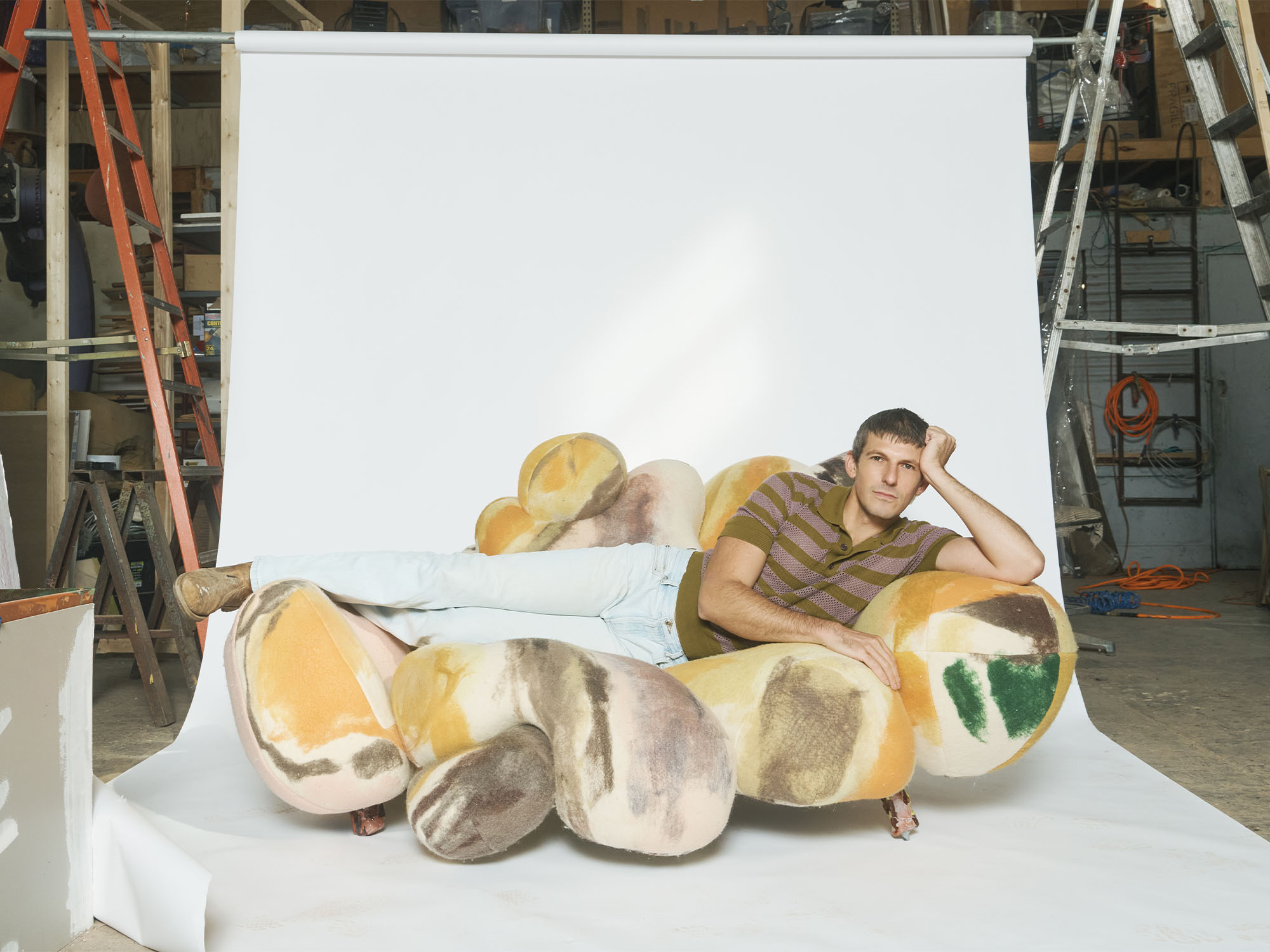
by Marco Sammicheli
Milano, 10 July 2026, afternoon.
Before speaking with Misha Kahn, I wrote down, almost instinctively, all the artists and authors his work brought to mind. We had met in Milan, and his work had unsettled me; I could not quite make sense of it. I turned the matter into an epistemological question, an intellectual challenge. What Glenn Adamson had written about Kahn suggested some highly compelling lines of interpretation, and I began to imagine an ideal atlas that might help me find my bearings. Hence the idea of compiling one for “(Kahn)Mishaland.” If I had to draw a real atlas for navigating the landscape of Misha Kahn’s suggestions and references, more or less explicit and acknowledged, I would name its visible and submerged territories after the many artists, designers, filmmakers and architects that his work evokes for me, or whom I imagine he is quoting, mixing, kneading, digesting, reworking and transforming as he works. If I had to identify the figures and suits in an imaginary deck of cards that the croupier Kahn shuffles, uses and plays whenever the occasion calls for it, these would be the personalities I felt I recognised as I explored his work:
Walt Disney, Frank Stella, Greg Lynn, Frank O. Gehry, Harry Bertoia; Gaetano Pesce, Andrea Branzi, Giancarlo Montebello; Estúdio Campana, Abraham Palatnik; Friedrich Kiesler, Friedensreich Hundertwasser; Antoni Gaudí; Niki de Saint Phalle, James Ensor.
São Paulo, 30 September 2026, morning.
The list should not be understood as a linear genealogy. Kahn does not seem interested in constructing a lineage, nor in demonstrating a stylistic filiation. Quite the opposite. His method appears to resemble montage in the very act of constructing his applied aesthetic: bringing distant languages together, making them collide, removing them from their original contexts and testing their ability to produce new forms. It is a practice that belongs as much to the culture of assemblage as to that of collage, but in his case, it assumes a three-dimensional, tactile and almost biomorphic dimension. Forms seem to grow rather than be designed, to accumulate rather than be composed, to mutate rather than be defined once and for all. Perhaps this is the first element through which I read All Intensive Purposes: not as a simple exhibition of new furniture, but as another episode in a research process that has progressively challenged the separation between object, sculpture, environment and process. Kahn, in fact, uses furniture as a kind of narrative device. Function remains present, but it is no longer the organising principle of the work. Rather, it is a gateway into a universe in which an object can take on the character of a creature, a landscape, an archaeological artefact from an imaginary civilisation. Kahn’s education at the Rhode Island School of Design, where he studied furniture design, might suggest a practice focused on overcoming the traditions of furniture design. Instead, it is precisely the concept of furniture that Misha seems progressively to have expanded. His work moves across furniture, lamps, mirrors, rugs, sculptures and installations without acknowledging a rigid hierarchy among these categories. His production often begins with sketches, models, material manipulations and hands-on experiments, but it can pass with equal ease through virtual reality, digital modelling, casting, moulding, welding, weaving or glassmaking. There is therefore no privileged technique: there is instead a readiness to engage with manual, mechanical, manufacturing and digital processes. This openness is decisive. Kahn does not use production processes merely to achieve a form conceived beforehand; often, it is the process itself that determines the formal outcome. Material thus becomes an interlocutor in the design process. He privileges none and excludes none; all participate in the tangible world. He manipulates material, forces it, bends it, layers it, covers it, melts it, stitches it and, above all, accepts its accidents. From this comes the apparently unstable, irregular quality that characterises many of his works: surfaces that seem on the verge of liquefying, structures that take on the consistency of organisms, volumes that appear assembled from fragments belonging to different worlds. The surface, in this sense, is one of the fundamental sites of Kahn’s research. It is not the neutral skin covering an already-defined structure; rather, it is the place where the structure reveals itself, alters itself and sometimes conceals itself. Colours, textures, reflections, protrusions, accumulations and layers give objects an epidermal dimension. The surface seems to possess an autonomy of its own, almost biological. It may recall a membrane, a mineral crust, organic tissue, animal skin, an extraterrestrial material. This is where the hypothesis of a comparison with Gaetano Pesce becomes particularly intriguing. Pesce transformed material into a form of storytelling, using resins, foams, fabrics and industrial processes in deliberately unorthodox ways. The surface of his objects could become image, memory, political gesture or anatomy. In Kahn too, material is not subordinate to form: it helps produce it and, at the same time, narrate it. The affinity is therefore not merely formal, but concerns a different conception of design, in which error, variation and imperfection can become compositional tools. It is no coincidence that Pesce is genuinely present in Kahn’s personal universe. He has repeatedly expressed his admiration for the Italian’s work, and keeps one of his pieces at home alongside works by Estúdio Campana and other authors who have expanded the boundaries of design. The relationship is therefore both cultural and material: Kahn belongs to a generation that inherited the possibility—won by Pesce and other radical figures such as Andrea Branzi, Piero Gilardi and Riccardo Dalisi—of considering furniture as an open territory between art, technology, craftsmanship and narrative. A second fundamental reference is Fernando and Humberto Campana, founders of Estúdio Campana. In their work, the everyday object is frequently removed from its functional destiny and transformed through poor materials, remnants, natural elements or fragments of everyday life. Kahn employs a similar strategy of transformation: material is not necessarily ennobled, but destabilised. What appears poor can become precious; what appears technological can acquire a handcrafted character; what belongs to the industrial world can be returned to a manual dimension. The proximity to the Campanas can therefore be read through their shared ability to construct an aesthetics of hybridisation. Yet while in the Brazilians’ work assemblage often carries a strong social, territorial and anthropological dimension, in Kahn a more fantastical, solitary component prevails, detached from the urgency of a relationship with context and community; more simply, it is speculative. His objects seem to come from a future we do not know, or from a parallel planet. Contemporary material culture is subjected to a kind of fantastic mutation. In this sense, the influence of Walt Disney may be less obvious but equally important. Not Disney as the author of specific forms, but Disney as a builder of polyvalent worlds. Kahn seems to share the ability to transform an object into a character and an environment into a narrative. His production does not simply offer things to be used: it constructs an ecosystem in which things seem to possess a personality. It is a logic I feel inclined to bring close to that of animated cinema, where every element of a space can be charged with character, emotion and behaviour.
Vienna, 4 October 2026, afternoon.
The same idea of world-building allows Kahn to be brought into proximity with Friedrich Kiesler. The Austrian-American architect conceived of the environment as a continuous organism in which furniture, architecture, body and space participated in a single system. His Endless House, like many of his installations, challenged the orthogonal geometry of modern architecture and proposed a fluid, almost biological conception of space. Kahn inherits, through a kind of photosynthesis, in a contemporary and playful form, this distrust of disciplinary separation. Friedensreich Hundertwasser can also be summoned into this atlas, not so much because of a stylistic resemblance as because of a shared resistance to modernist neutrality. Both transformed the architectural surface into a site of proliferation, colour, decoration and variation. In Kahn’s work, ornament is no longer, as it was in the modernist tradition, an addition to be eliminated: it is a generative component of form. Detail can produce volume just as much as volume produces detail. Another relationship that emerged for me is that with Harry Bertoia, which leads in a different direction. Bertoia is an emblematic case of an artist and designer capable of destabilising the distinction between furniture and sculpture. His metal seating grew out of an investigation into structure and material that transcended mere function, while his sculptural production explored the behaviour of metal in space, light and sound. Kahn too seems to move along this threshold: furniture is never merely furniture because its sculptural presence precedes and sometimes exceeds its utility. The same could be said of Andrea Branzi, particularly in his ability to understand design as a form of critical inquiry into material civilisation. For Branzi, design is not merely the solution to problems, but the production of images and hypotheses concerning the relationship between the individual, technology, nature and society. Kahn operates in a less theoretical and more instinctive territory, but shares the conviction that design can construct worlds rather than merely satisfy needs. The list of references could continue: Abraham Palatnik for his ability to transform movement, technology, light and colour into a visual experience; Niki de Saint Phalle for chromatic energy and for freeing form from the discipline of proportion; James Ensor for the grotesque, theatrical and almost carnivalesque dimension of surfaces; Frank Gehry for the idea that irregularity and deformation can become constructive principles; Greg Lynn for moving beyond Euclidean geometry through fluid, digital and animated forms; Frank Stella for the progressive emancipation of the pictorial surface from two-dimensionality. As I said at the beginning, however, these references should not be turned into a list of influences. Kahn’s particular quality lies precisely in the fact that such images are digested until they become unrecognisable. The reference is not quoted: it is metabolised. The resulting form is often too eccentric to be traced back to a single source. It is a composite form, as if the history of design had been subjected to a process of digestion and subsequently expelled in a new configuration. From this point of view, All Intensive Purposes can be interpreted as another stage in the construction of this grammar. The expression itself—with its deliberate linguistic ambiguity—suggests a project in which meaning does not necessarily coincide with intention. Kahn’s objects seem, in fact, to inhabit precisely the distance between what they are and what they appear to be. A chair may look like a creature, a lamp like an organism, a table like a geological fragment. Use does not disappear, but is suspended. It is this suspension that makes Kahn’s work particularly significant within the landscape of contemporary design. After decades in which the discipline has often identified its value with clarity of function, productive rationalisation and formal reduction, Kahn reclaims the possibility of excess. His work does not necessarily want to be more efficient, lighter, cheaper or more discreet. It wants to exist and to be memorable. But Kahn’s excess does not simply coincide with decorativism. It is a method of knowledge. Accumulating materials, techniques, references and forms means testing the categories through which we are accustomed to recognising an object. When a piece of furniture looks like a sculpture, when a sculpture can be used as furniture, when an industrial material takes on an organic character and when a craft process is controlled through digital tools, design becomes a laboratory in which the very definitions of design are put to the test. From this perspective, the true protagonist of Misha Kahn’s work is not the finished object, but the process of transformation. Material enters the studio with a certain identity and leaves it altered; an industrial technique is diverted towards an unforeseen result; a functional form is pushed to the threshold of sculpture; a historical reference is absorbed and returned as something belonging to the present.
Bilbao, 5 October 2026, morning.
The croupier Kahn continues to shuffle his deck. The cards of design history are not arranged in chronological sequence, but thrown onto the table, overlapped, turned over, recombined. The game is not about establishing who came first and who came after, nor about demonstrating a line of descent. It is about testing what happens when Pesce encounters Disney, the Estúdio Campana meet science fiction, Kiesler meets virtual reality, and the ready-made meets craftsmanship. But perhaps, at this point, the metaphor of the deck is no longer sufficient. For Kahn does not seem merely to gather and reshuffle images drawn from the history of art and design. Rather, it is as though he were looking out across an immense landscape without seeking to possess it, definitively map it, or reduce it to an orderly system. He contemplates it from a singular position, allowing the forms, intuitions and obsessions of other authors to enter his field of vision, draw close, contaminate one another and come to life again in unexpected configurations. He is not necessarily searching for predecessors, but encountering kindred spirits. Authors separated by time, geography, discipline and intention become his contemporaries through an affinity that requires no proof of direct lineage. It is as though Kahn inhabited an already populated cosmos, in which every form retains the memory of what it once was and, at the same time, the possibility of becoming something else. In this cosmos, however, nothing is reduced to the sum of its parts. Kahn’s uniqueness does not lie in inventing a language impervious to history, nor in his ability to escape the images that precede him. On the contrary, it lies in his capacity to move through them without allowing any one of them to define him. His originality is not an absolute point of departure, a declaration of independence from everything that came before, but the outcome of a process of appropriation, transformation and restitution, in which every encounter changes both the object and the gaze that brings it into being. The affinities are recognisable, sometimes even startling, but they never become an exhaustive explanation. Pesce alone cannot explain Kahn, just as Disney, Branzi or the Campanas cannot be invoked to resolve the meaning of his forms. Each opens a door; none points to the exit. Rather than functioning as a repertoire of models to replicate, history becomes a living material, available for new combinations and new possibilities of existence. It is within this tension between uniqueness and multiplicity that Kahn’s work perhaps finds its deepest quality. Multiplicity does not dilute the artist’s identity but makes it possible; uniqueness does not erase the voices that pass through it but gives them a new opportunity to exist. His objects carry traces of a potentially infinite number of worlds without belonging entirely to any of them. They are irreducible forms, yet relational; singular, yet inhabited. Their eccentricity does not stem from being alien to history, but from making it available to the imagination once again. In this sense, Kahn does not simply add a chapter to the history of design: he reopens its pages, shifts its boundaries and makes permeable the distinctions between art and design, memory and invention, what we recognise and what we have not yet learned to name. The result is a form of design that does not primarily ask to be used. It asks to be looked at, touched, mentally traversed. Only afterwards, perhaps, does it ask to be used. His furniture does not renounce function: it transforms it into a narrative device. It does not cease to be made of objects: it becomes miniature worlds, presences that seem to emerge from a universe larger than the one we can see. And perhaps this is precisely why its encounter with history produces neither nostalgia nor quotation, but an unexpected form of contemporaneity: Kahn looks out across a landscape of authors, forms and ideas that preceded him and, without claiming their place, takes his seat beside them, at least in the imagination. He becomes their kindred spirit without becoming their imitator, part of a constellation without relinquishing his own orbit. His work thus reminds us that originality does not necessarily coincide with isolation, and that a voice can become all the more recognisable the more capable it is of welcoming other voices. Uniqueness, after all, is not the opposite of multiplicity: it is the irreproducible form that multiplicity assumes when someone succeeds in giving it a body.

