By Debika Ray
October 1, 2026
Six years ago Oliver Spendley, a traditional boat builder trained on England’s south coast, moved to the north-west of Scotland. There, in the Highland landscape formed millions of years ago by a tectonic collision, he gathers monolithic stones and combines them with carved wood to create sculptural furniture: tables whose jagged stone legs penetrate through smooth timber tops.
His material of choice is gneiss. “I’m drawn to pattern and layers,” he says of the metamorphic rock, which is formed as pressure and temperature act on igneous or sedimentary rocks. Its distinctive bands of colour are “like grain in timber,” he adds. Whether working with smooth stones collected on beaches or rugged chunks he finds inland, he interferes as little as possible with the raw material — occasionally shaping it to accentuate its natural qualities, but often leaving it just as it is.
Spendley is tapping into an ancient sensibility: think of gongshi rocks, traditionally appreciated by Chinese scholars, or the Makapansgat pebble, a “ready-made” artwork that preceded Duchamp by 3mn years. Japanese-American designer Isamu Noguchi — who focused on stone carving later in his career — observed the enduring nature of this fascination in a 1980 interview with The New Yorker magazine. “When you get to the furthest point of technology, when you get to outer space, what do you find to bring back? Rocks!”
“Natural rocks have been admired since the dawn of humanity,” says Costas Paraskevaides, director of gallery ArtAncient, which sells fossils containing botanical formations, Bronze Age obsidian cores, shards of ammonites and naturally formed, swirling sandstone formations called gogottes. But like Spendley, he has recently noticed an increased interest in such objects, pointing to his sellout show of gogottes at Masterpiece London in 2022 and a growing demand for meteorites since the pandemic. In New York last year, Sotheby’s sold one from Mars for $4.3mn.
Hettie Judah, author of the 2022 book Lapidarium: The Secret Lives of Stones, speculates that current anxieties about climate change and geopolitics might have something to do with this turn to natural geological objects that have been around longer than we can comprehend. “It can be comforting to think about how tiny the period of human impact on the earth is,” she says.
She suggests it might also be fuelled by wellness culture, with its celebration of crystals and minerals — and even the rugged masculinity promoted via the so-called manosphere.
But many of the designs emerging as part of this movement are less caveman than rock chic. Mexico City-born Damaso Mayer, founder of Estudio Material, contrasts craggy rock offcuts with sleek metal sheets to create simple yet surreal benches, tables and sculptures. For him, it’s placements, juxtapositions and combinations that elevate the materials. “A stone at the stone yard looks ordinary, as does a sheet of metal on its own — it’s by merging the two that you appreciate them,” he says.
He started making sculptural works two years ago, building on his experience as a landscape architect, for which he created outdoor stone features. Like Spendley, he has a light-touch approach. “Over-manipulation can lead to stone losing its soul — it’s like you’re peeling off layers of history.”
London-based South African designer Lea Colombo and others have a similar ethos. Colombo creates monumental, vibrant tables made of stacked red jasper, rose quartz, sodalite, serpentine, tiger’s eye and green onyx. Belgium’s Maarten De Ceulaer’s stacked lights are inspired by granite boulders in the Pyrenees. Netherlands-based Spanish designer Pepe Valenti’s jagged lamps reference how the sea shapes the coastline.
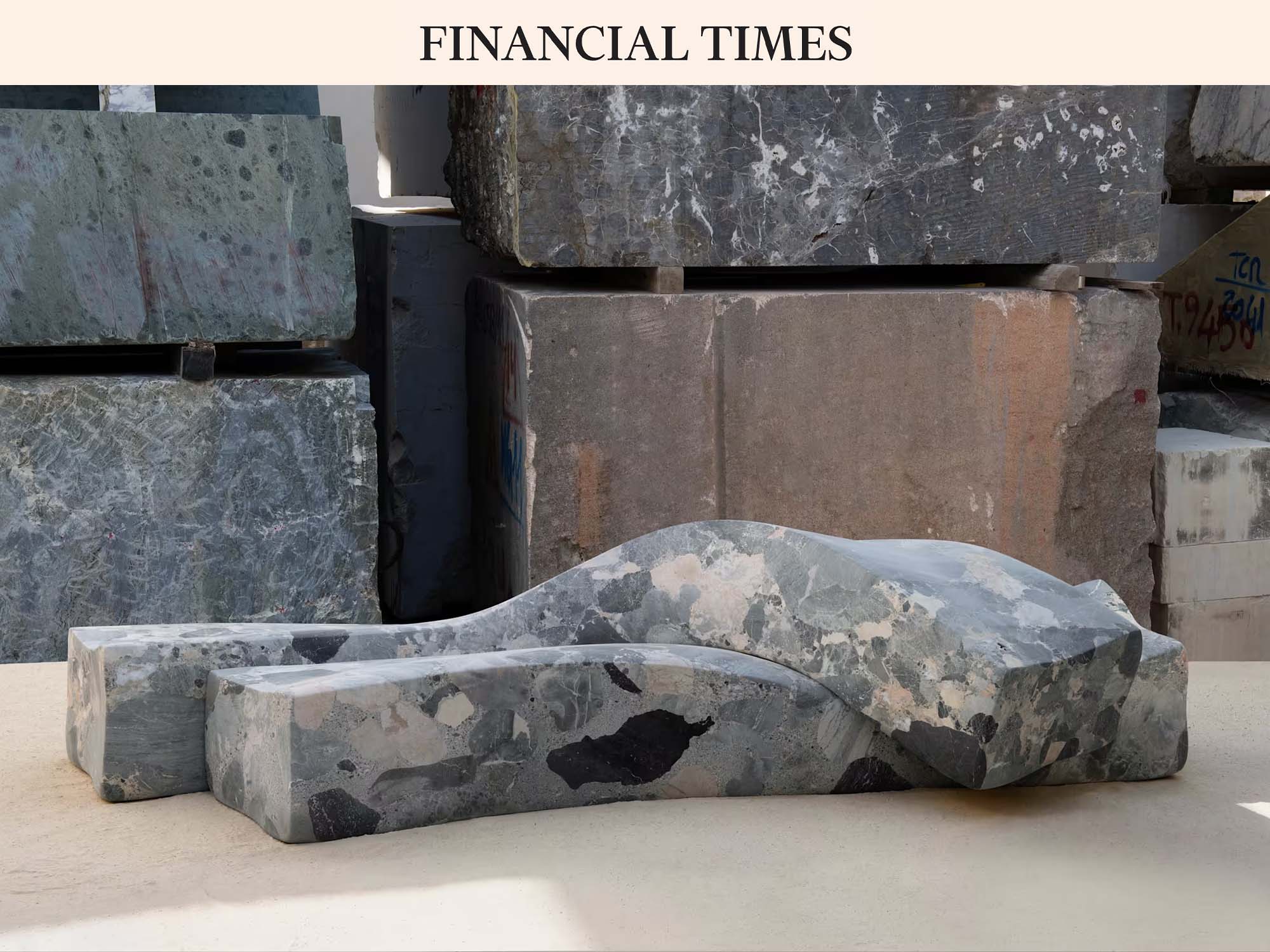
But it’s not all about the combinations; for other designers it’s about unlocking hidden facets. Lebanese-French designer Najla El Zein first started to sculpt stone in the early 2010s in a workshop in Beirut. She works with a long-standing team of artisans to create sensual, fluid-looking seating and sculpture; uncovering the overlooked appeal and hidden poetry is the joy and challenge. “Stones have been around for thousands of years, shaped by the earth,” she says, yet despite their hardness, their permanence, “there was an intimacy and softness to the material that surprised me”.
She and her studio create both permanent public sculptures — such as one being unveiled in Melbourne in December as part of the NGV Triennial — and more intimate ones: her piece “Lovers Bench” has two dappled lengths of stone entwined affectionately around each other.
She thinks of the material as an active and unpredictable collaborator. “Each stone has to be approached with different gestures, even when using the same technique,” she says. “If you know the time it has taken for this material to be created, you also understand that it takes time for it to give back.”