By Emma Crichton-Miller
September 18, 2026
The sculptor Wendell Castle was a towering figure within the American art furniture movement. In the years since his death in 2018, museum and gallery retrospectives have confirmed his place within a pantheon of artists for whom furniture-making was not just an amusing sideline of a creative life, but the primary medium for their artistic vision. This autumn, Friedman Benda, Castle’s long-term New York gallery, has teamed up with his daughter, Alison Castle, to honour the domestic origins of his transformative practice.
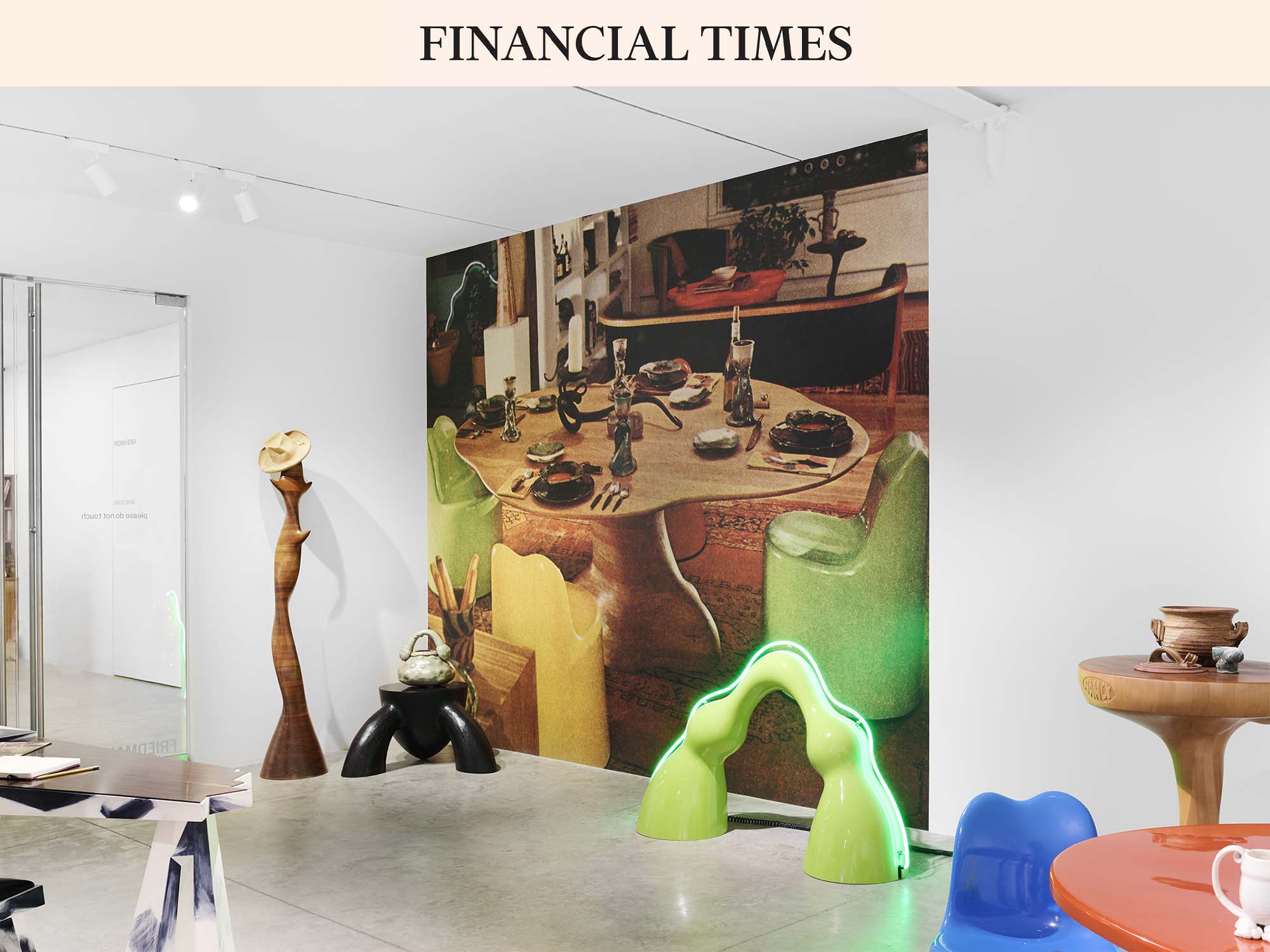
Wendell Castle: Living recreates the interior of the open-plan loft of the former mill in Scottsville, New York, where Alison lived with her father and mother, the ceramic artist Nancy Jurs, in the late 1960s and 1970s. Here, art and craft were part of the ongoing stream of life, fed by their circle of friends. It was this intimate, experimental environment, the exhibition suggests, that gave birth to furniture and sculptural ceramics of striking originality. The show’s aim, Alison says, is “to impress on people that we lived with these pieces”.
Castle and Jurs converted the mill near Rochester into a living and workshop space in the late 1960s. At the time, Wendell, born in 1932, was already an important figure in the American studio furniture movement, teaching at the School for American Crafts at the Rochester Institute of Technology and later at SUNY Brockport. Jurs, born in 1941 and an RIT graduate, focused on functional raku-fired pottery.
The home was filled with their creations — one-off pieces of wooden furniture sculpted into biomorphic forms, seemingly growing from the floor, Castle’s curvaceous plastic furniture and Jurs’s ceramic objects, from generous bowls to spiralling goblets. Marimekko textiles from Finland and kilim rugs added warmth and colour. Although Alison remembers the Rochester area as “a cultural desert”, her parents’ friends and colleagues from RIT, along with visitors from further afield, were frequent guests, and their ceramics, furniture and artworks also found their way into the house. These included the ceramic sculptor Roy Cartwright, artist and furniture maker Tommy Simpson, who exhibited with Castle in the groundbreaking 1966 New York exhibition Fantasy Furniture, and the British textile artist Ann Sutton.
The home reflected the increasing blurring of the lines between art, craft and design at this time, an ethos exemplified by the groundbreaking exhibition Objects: USA at the Smithsonian in 1969, where Castle featured prominently. Gallerist Lee Nordness, co-curator of the exhibition, which toured to more than 30 locations in the US and Europe, later wrote: “Placing paintings and sculpture into a convenient ‘fine arts’ category, and objects — whether functional or non-functional — into a craft category no longer sustains any aesthetic validity.”
Yet the melding of life and art was not always practical. Alison explains that in the late 1970s, as her father worked increasingly with gel-coated fibreglass, the smells rising from his studio into the loft became unbearable. “When it got into my milk, my mother said it was time to leave.” They moved out, taking some of the furniture with them, but the spirit of the house was lost.
Alison, who was six at that time, would later scour the few photos from that period to catch glimpses of this barely remembered realm. Then, a few years ago, leafing through a family scrapbook, she found a clipping from the magazine House Beautiful, dated June 1973, featuring the entire apartment in photograph after photograph. “I was floored,” says Castle, who in 2023 co-founded the Wendell Castle Workshop in her father’s former Scottsville studio to preserve his legacy by teaching skills and encouraging creative furniture-making. The discovery provided the seed for the new exhibition.
Today Castle’s seminal furniture designs are most often seen in museums or art galleries in presentations that emphasise their formal and technical originality. But when Alison showed Marc Benda, co-founder of Friedman Benda, the 1973 article, he saw a different angle: “not only the evocation of an artist’s home in the early 1970s, but a way of life, a way of living with these objects, which I hope we can transmit to the public,” he says.
Castle’s sculptural ambition was clear from the start. Having trained in industrial design and completed a master of fine arts in sculpture at the University of Kansas in the early 1960s, he began his career making abstract works in wood that displayed a refined sensibility, influenced as much by sculptors like Isamu Noguchi and Jean Arp as by the furniture maker Wharton Esherick. But in 1963, he moved more firmly into furniture design. He later wrote: “It was clear to me that if I continued with sculpture I’d have a tough row to hoe, but if I went into furniture there was no competition.”
Around this time, Castle’s pioneering of stack lamination (where multiple layers of thick wood are bonded together) enabled him to carve swooping organic shapes that he couldn’t achieve with conventional joinery techniques. Experiments with fibreglass, bronze and even robotic carving followed, leading to increasingly ambitious designs.
But beyond these formal experimentations, the exhibition suggests, Castle was pursuing a philosophy exemplified in his home. Unlike many other modernist designers, he did not set out to purify his furniture of everything but function. Instead he used function as a springboard for the imagination. You want a chair? How about a three-seater, like the one pictured in the 1973 article, which can hold a small family in its hollows, as if in a tree. You need a desk and chair? How about one that evokes the weird expressionist set design and disorientating lighting of the 1920 silent film classic The Cabinet of Dr Caligari, bringing the radical early 20th-century imagination alive in your home?
The same spirit is evident in Jurs’s ceramics, ostensibly functional pieces with an exuberant quirky energy and seething with expression, paving the way for her later sculptures. The works of both artists are a response to a specific context: as much emotional and intellectual as architectural.
Out of this playfulness grew the works on display in the exhibition. Dividing the gallery into a sitting area, kitchen and dining areas, office/entryway, and bedroom, the exhibition features a sinuous wooden music stand from 1962, evoking the role that music played in their family life; a 1964 walnut stool, its delicately curvy legs like a sea anemone; and a 1973 walnut coat rack, spiralling elegantly from the floor like a lady in an evening gown, a character within the comings and goings of family and friends. From Jurs, there is a pair of kitchen containers that look like singing mountains and a cheerfully lopsided chocolate-coloured ceramic dog with too many legs, among other vivid, humorous pieces.
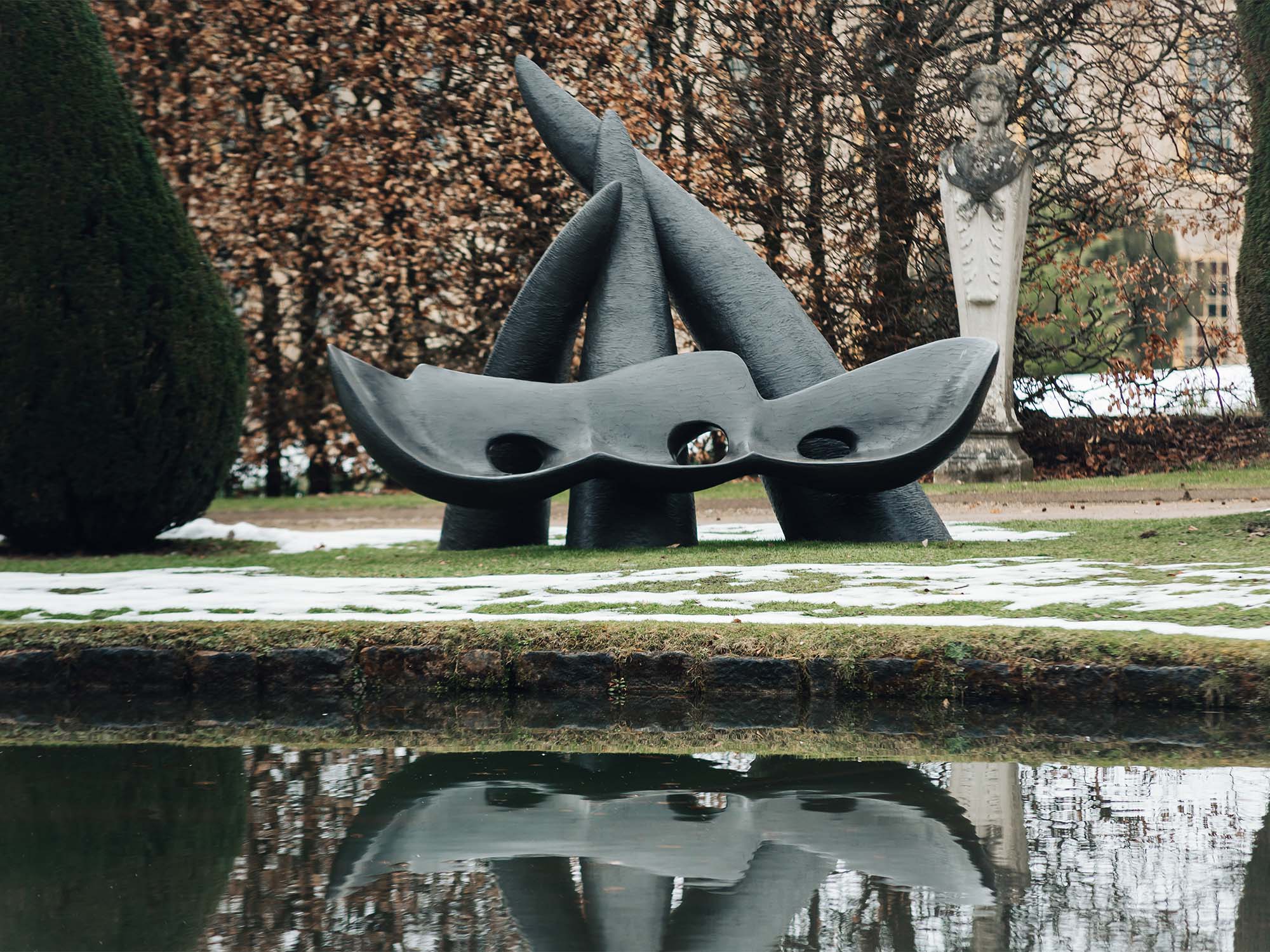
In this context, furniture and ceramics become dramatis personae within a family home. One especially lovely piece is the floating stained-mahogany three-seater settee from 2010, recalling a similar one made for the Rochester loft. Called “Arcadia”, it seems to gesture back to that world, which for Alison has always seemed like a paradise lost.