by Simon Andrews
By 1950 Carlo Mollino was firmly established as a talented and visionary creator, on the arc of international acclaim. The Brooklyn Museum had, by November of that year, received from the architect an extensive portfolio of innovative and experimental furnishings for the multi-loan exhibition ‘Italy at Work: Her Renaissance in Design Today’ that would soon travel to twelve further US institutions. Adjacent to this valuable exposure, a recommendation from Gio Ponti had evolved into an agreement with the American retailer Joseph Singer for certain of Mollino’s furniture designs to be distributed in the United States. Simultaneously, in his home town of Turin, Mollino was co-ordinating the final furnishing details to the sumptuous bespoke apartment overlooking the river Po, created for his client Count Vladi Orengo.
Mollino’s creative momentum had evolved steadily since the early 1930s. His prewar concepts for interior design and furnishings, notably the Casa Miller and Devalle, were highly personalised schemes that owed much to the prevailing influence of surrealism, however further projects stalled with the advent of war. The liberation of Turin in April 1945 demanded rebuilding and reconstruction, and there soon followed an impressive series of elaborately furnished apartments commissioned by private clients including those for the engineer Paolo Albonico, the art dealer Ada Minola and her husband, and an adjacent apartment for her brother-in-law, Guglielmo Minola. Mollino’s own apartment, the Casa Miller, had been destroyed by bombing early in the war and in 1947 he arranged a small studio apartment, populated with furniture of his own design that revealed his increasing interest in vernacular types of Alpine furniture.
As the austerity of the 1940s folded into a new promising decade, Mollino was now poised and experienced to capitalise upon new opportunities. He could now evolve some of the inspirations, concepts and structures of those earlier projects to broader commercial applications. In early 1951 Mollino was approached by Mario Lattes, who had recently assumed directorship of the eponymous publishing house originally founded by his uncle Simone in 1893. Mollino’s instruction was to reinterpret the interior spaces with furnishings that reflected the company’s modern and refined style. To date, all of Mollino’s interior furnishing projects had either been for domestic private clients, or had been furnishings, including those currently being shown on the ‘Italy at Work’ tour, that were essentially conceptual or prototypic samples. An exception was a small group of office furniture, including oak trestle desks and chairs, created for the Reale Mutua Assicurazioni, Turin, in 1948-49.
For the Casa Editrice Lattes Mollino submitted the broadest and most diverse range of furniture, lighting and fittings of any project to date, for use in a working environment in which engagement and efficiency would be paramount. Conforming to the precise requirements of specific roles within the company, Mollino designed three types of desks and conceived of at least three types of chairs for the working office spaces. He also created a dramatic plywood conference table, an evolution of the example at that time on loan to the 1951 Brooklyn Museum exhibition, together with fourteen high-back chairs. A library bookcase and four lounge chairs completed the public client-facing areas. Mollino’s final blueprints for most of the furniture were resolved by August 1951, and the Lattes interior was completed around six months later, in time for publication in Domus, April 1952. The speed with which the project was conceived and subsequently delivered reveals Mollino’s certainty of concept and fluency of process.
To harmonise the various furniture types Mollino utilised either pale solid ash wood, or light maple plywood. Resinflex vinyl upholstery in either white, green, red or yellow was applied to the various chairs and to the padded doors, delivering punctuations of colour. The library bookcase featured sliding doors of sky-blue tinted glass. Any fixtures, fittings or accents were made of brass. Suspended from the ceiling of the office spaces was an elongated illuminated box unit from which multiple adjustable brass-armed spotlights or reflectors were issued. Collectively, the components of the offices offered a stylised, balletic synchronicity. As if mechanical tendrils of an imaginary forest canopy, the ceiling light frames furniture that appears timelessly modern or lusciously organic. Accented by flashes of succulent colour, the holistic Lattes interior reveals anthropomorphic stage-craft within the coded theatre of a fantastic super-Nature. These were concepts initially explored within the earlier Minola M1 and Orengo apartments, but were now integrated with anatomical efficiency upon the demands of a commercial office environment.
Mollino’s most effective interiors, of which Lattes is included, evolved direction from myriad and diverse interests fermented to a metaphysical whole. As an engineer and architect, and the holder of various technical patents, he had detailed competence for structures and their capabilities. As an acrobatic pilot, experienced and skilled skier, and racing-car driver he mastered momentum, balance and energy. Another critical and persistent fascination for Mollino remained traditional Alpine architecture, and the artisanal-made vernacular furniture these structures contained. In 1930 Mollino had studied and meticulously recorded types of traditional architecture in the nearby Val d’Aosta region. These studies informed a series of Alpine and mountain buildings that included the Lago Nero sled-lift lodge, the Furggen cable-car station, the Casa Cattaneo, and eventually, the Casa Del Sole resort in Cervinia, all designed by Mollino and executed between 1946 and 1954.
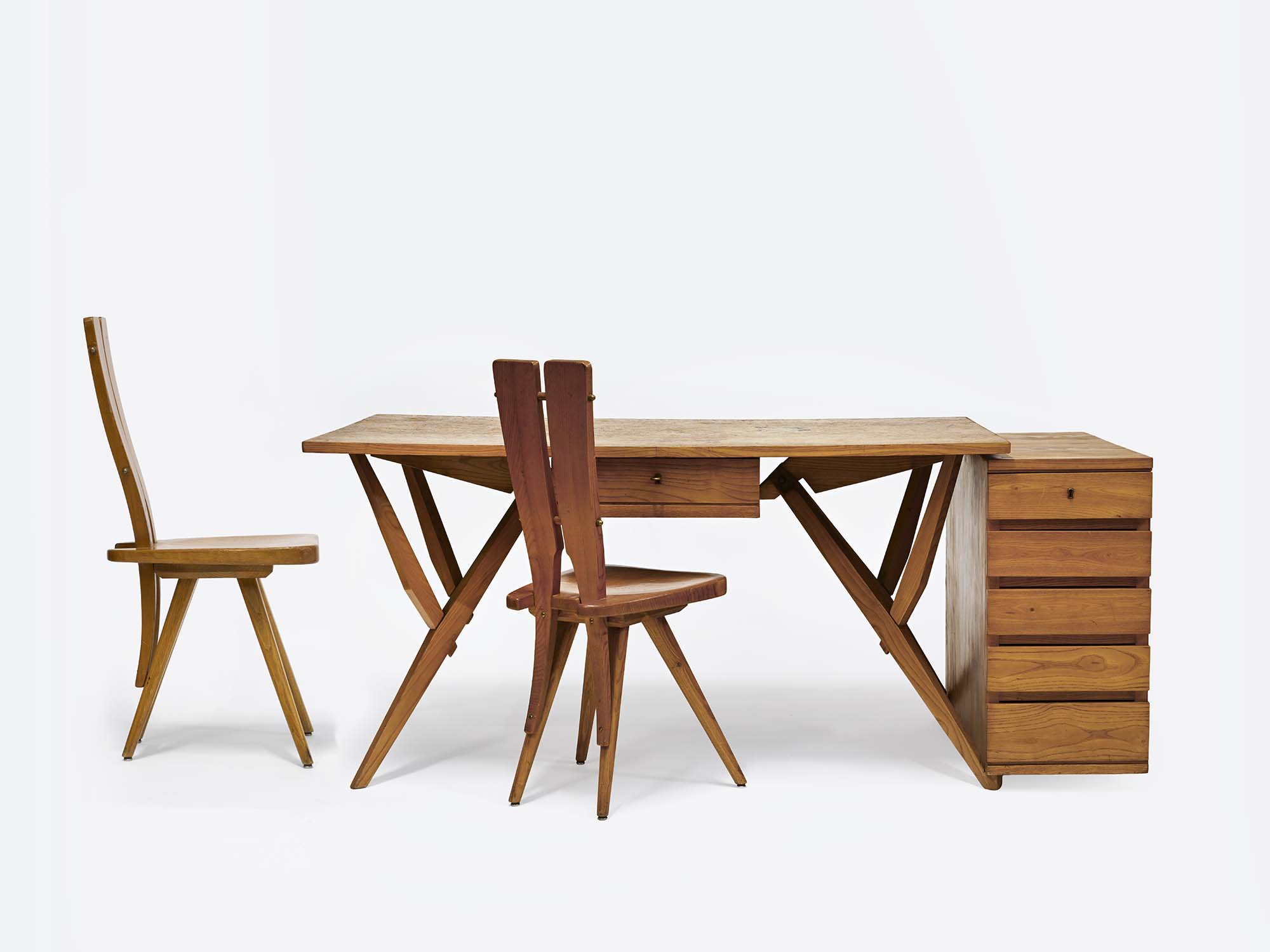
The trestle desks that Mollino designed for Lattes were directly informed by Mollino’s passion for vernacular Alpine archetypes, and reveal the jointed and trussed structures, together with local indigenous timbers, that establishes this concept within the narratives of tradition albeit now streamlined for modern statement. According to research, six examples of trestle desks were delivered to Lattes, however only four now remain accountable, one of which is currently in the collection of the Vitra Design Museum. The refined architectonic frame of the desk encloses a single central drawer, and supports a separate drawer case unit that could be mounted to either the left or right-hand sides. The top was manufactured from a progressive new material, described on the table’s August 1951 blueprint as ‘panforte resina pressato’ but known latterly by the brand name, Fibrosil. This was a bonded, resin-impregnated wood derivative, that appears to have been selected by Mollino specifically for its sound-deadening qualities to muffle the clatter of the typewriters used by the Lattes clerks. Intriguingly, Mollino’s adoption of this material predates its commonly-accepted 1963 patent in California. Photographs of the Lattes interior taken later in the 1950s illustrate that eventually a durable wood-effect plastic laminate would be applied atop the Fibrosil desk surfaces, and also to exposed flanks of the solid ash drawer case units. The present desk and drawer case evaded these later modifications and therefore remains, possibly uniquely amongst surviving examples, exactly as determined by Mollino’s original blueprint for the design. Mollino’s furnishings for Lattes remained in use over ensuing decades, until subsequent renovations of the interior resulted in surviving furnishings being dispersed onto the collector’s market in 1981.
The pair of oak and chestnut chairs that accompany the present desk transcribe directly from Mollino’s fascination with traditional robust Alpine furniture. The earliest prototypic interpretations of this chair concept, with a bifurcated back that tapers to the floor, date to around 1946-47 and were employed in the Casa Minola M2, as well as in Mollino’s own apartment. By 1953 those earlier tripod forms had matured to the present four-legged iteration of which the first six variants were supplied to the Casa Cattaneo private house, Agra, with around one hundred and fifty further examples supplied to the Casa del Sole mountain sports residency in Cervinia. At both Agra and Cervinia, this chair design was to be associated with a matching dining table, either square or rectangular, that derived directly from the present trestle desk designed for Lattes.
Mollino’s interiors and the furniture created for those spaces represented an ongoing evolutionary narrative, as expression of content and innovation of form matured according to context. The furnishings created for the Casa Editrice Lattes were executed during the apex of Mollino’s creative influence, fluently revealing the synergetic alliance of technical pragmatism with the coded, personalised symbolisms upon which his important legacy is defined.
